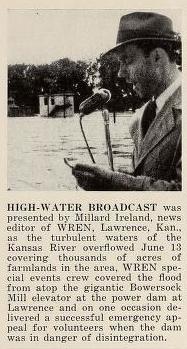
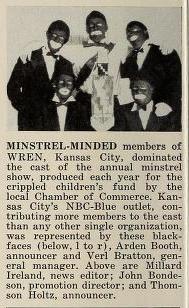
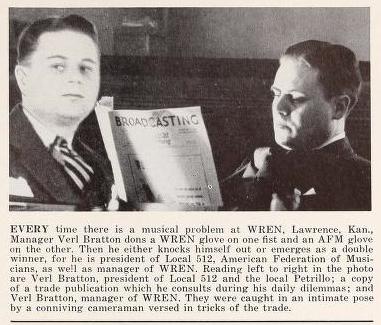
A microphone set on top of a pile of empty flour sacks and a cockroach-infested room which doubled as an announcing studio. This was an inauspicious beginning for Lawrence’s first commercial radio station, WREN, which originally went on the air in 1926 but was officially launched in April, 1927, when the Federal Radio Commission authorized the station to broadcast on AM 1180 (this was before stations began using the FM frequencies). One man, Vernon “Bing” Smith kept the ramshackle operation running, performing just about every necessary job himself, from announcing to writing to maintaining the equipment.
WREN hit the air under the watchful eye of R. C. Jackman, head of the Jenny Wren Milling Company, later the Bowersock Milling Company. The broadcasting venture was originally devised as a means of advertising for Jenny Wren and their Ready-Mixed Flour. With commercial radio just barely six years old when WREN went on the air in 1926, there were few professional standards for Jackman and Smith to follow. Therefore, they decided the river-front mill itself would make a fine spot for the operation of both the studio and transmitter. A storage elevator seemed a natural spot for the antennae.
Around 1928 the station became an affiliate of the Blue network, one of two radio chains owned by the National Broadcasting Company (NBC). Years later the courts made NBC sell one of its two broadcasting chains and the Blue network became the core of the the American Broadcasting Company (ABC). By 1929 this affiliation allowed the Lawrence station to carry perhaps the most popular radio program of all time, Amos ‘n’ Andy, which originated from Chicago six nights a week. During this same period the station, in a nod to its parent company Jenny Wren Milling, also carried The Biscuit and Pancake Program for early risers at 6:30 in the morning and The Jenny Wren Cooking School a few hours later at 9:30.
During the mid-1930s WREN broadcast some of the most memorable radio programs of all time. Most prominent among them was The Jack Benny Show, a Sunday night radio staple for twenty years. Years later Benny would be one of the few radio stars who transitioned successfully to television. Only slightly less popular was Fibber McGee and Molly, a comedy centering around the exploits of the bumbling and blustery Fibber and his eternally patient wife Molly. This show, too, aired for two decades but was unable to make the jump to television. For children, WREN carried Little Orphan Annie, a spin-off of the popular comic strip, every afternoon.
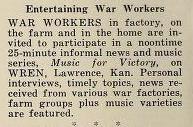
WREN continued to entertain northeastern Kansas after World War II broke out with the adventures of Jack Armstrong, All-American Boy and The Lone Ranger. Newsman Walter Winchell kept station listeners updated on news from the global conflict.





 Wistful Vistas