
Month: May 2024
A-G Musical Grocers, pt. 2
The series revolved around two main characters, Al Short and George Tracy (A and G) who owned an A-G store in the fictional Maple Grove. Al was played by Gomer Cool and George by Paul Henning, the show’s writer. Henning would eventually go on to write at the network level make his name in television as the creator of The Beverly Hillbillies. Cool related that Al and George “greet the customers – sell them the various A-G specials just as any grocer would do.” Utilizing their singing talents, Cool and Henning would “sing praises of their A-G store and its products.” The duo parodied popular tunes of the day, rewriting lyrics to focus on Associated Grocers products and sales.
Al and George were joined by Olaf, the meat cutter’s assistant. Paul Sells, simultaneously a member of KMBC’s Texas Rangers and later musician for Gene Autry, voiced the Swede and pitched in with some accordian music, even adding his baritone on occasion. Stock boy Elmer Jones, the slow but loveable town inventor, was played by Herb Kratoska (also concurrently a member of the musical Texas Rangers) who added guitar when required. The final core character as Flash, a Black delivery boy who provided comic relief. Portrayed by Eddie Edwards, Flash was one of several Black characters Edwards played on different KMBC series, among them “Cookie” on Life on Red Horse Ranch, “George Washington White” on Happy Hollow, and “Sam” on Joanne Taylor’s Fashion Flashes.
Other KMBC actors passed through Maple Grove playing various customers, among them Mrs. Straightlace, “the town reformer,” Mrs. Gabriel (Gabby), who never stopped talking, and Mr. Gardiner, a newlywed, Grandma Perkins, Freddy Finch, Dr. Ford, Mrs. Murphy, Mr. Weston, and Miss O’Neil.
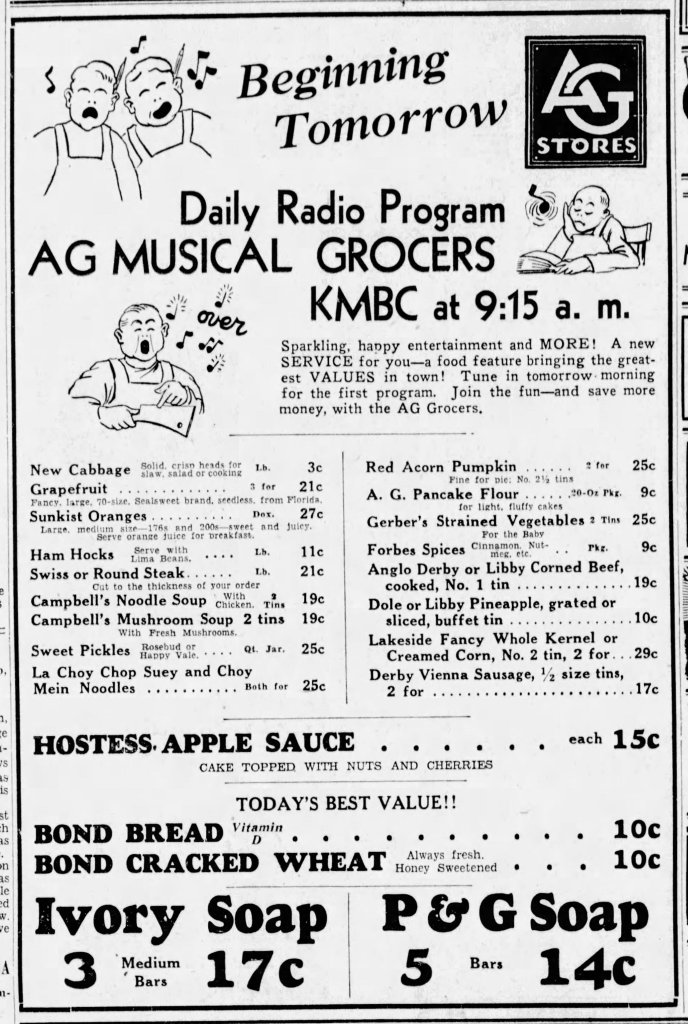
Henning daily wrote specific goods into the script that A.G. Stores would then have on specials that same day. These same goods were advertised in the daily newspapers as well. Given the unfortunate lack of surviving scripts, modern fans can only surmise how goods such as Derby Chili, Lakeside Vegetables, and Aines California Cottage Cheese were deftly woven into the “fast moving, jolly” storyline which supposedly carried “a thread of human interest from day to day.”
Despite the future success of so many of its cast, Musical Grocers wasn’t the sales driver for which A.G. Stores hoped and the series said “Auf Weidersehen” on July 11, 1934. There is no indication in extant KMBC records that they attempted to revive the series with a different sponsor.
A-G Musical Grocers, pt. 1
Researching old-time radio programs can be a feast-or-famine endeavor. Due to the happenstance of history, we as a hobby are blessed with abundant documentation about some areas of the broadcasting industry during radio’s Golden Age but absolutely nothing about other areas of that radio era. Fortunately, Arthur B. Church, the founder of Kansas City’s CBS-affiliate KMBC, was quite thorough in holding on to station records and documents for decades, from the station’s beginnings in the mid-1920s to its sale in the early 1950s.
Radio historians are further fortunate that Church, instead of destroying the records upon his retirement, decided to hold on to them and eventually donate them to a university library that was willing to preserve them for decades. This has allowed us fans of the era to do in-depth research and writing about the original programming of a mid-size market station, an unusual feat in contrast to the national and regional network programming that has been a bit easier to document.
An example of the shows into which the KMBC archives allow a modern insight is A.G. Musical Grocers, a daily (except Sundays) series that aired over the station in 1934 from Thursday April 12 to Wednesday July 11 for a total of 78 episodes. Interestingly, this was the third series in as many years that bore the Musical Grocers title, the earlier two possibly serving as a level of inspiration for the third. In 1932 CBS broadcast a weekly series The Musical Grocer starring Irving Kaufman, and in 1933 NBC aired The Musical Grocery Store featuring Tom Howard, Jeannie Lang, Tiny Ruffner, and Billy Best.
In the KMBC series the “A.G.” stood for Associated Grocers, a group of independent grocers in Kansas City who in 1924 banded together to protect their market share against the larger chain grocers. By combining their orders from product manufacturers and storing their respective goods at a single location, the independent stores could get more competitive pricing in line with the chains. One hundred years later the organization continues on as Associated Wholesale Grocers.
In 1934 the Associated Grocers approached KMBC about designing a program to promote aligned stores and specific products they wanted to advertise on a given day. The result was the quarter-hour A-G (or A.G.) Musical Grocers. In an inter-office memo written by station writer-singer-actor Gomer Cool (profiled here) described the program as “a combination of music, comedy, and intensive selling.”
 Wistful Vistas