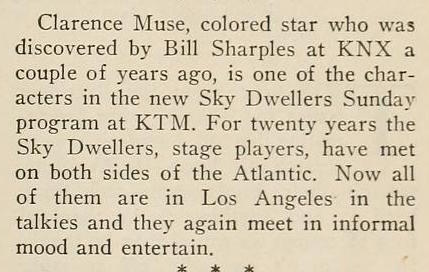
The Johnson Sisters (aka. The Barn Warmers, aka. The Musical Cowgirls)

I know little of the late-1930s musical act that went by the name The Johnson Sisters, The Barn Warmers, and The Musical Cowgirls. The trio was made up of Velma (Grandma), Icel (Ma), and Doris (Baby), three women who performed over Kansas City’s KXBY ca. 1937 – 1938. They came to my attention thanks to a contact by one of their family members and so far I’ve managed to dig up very little on the band.

“Hillbilly” bands – as they were frequently called – like this were very common in the Midwest during this era and the vast majority of them are poorly documented, if documented at all. Because KXBY appears to have been an experimental radio station at least partially owned by Arthur B. Church, head of Kansas City’s KMBC, I was hoping to find some historical items on the band in the various Church archives. But no such luck so far.

Here’s some nice background on KXBY – formerly W9XBY – an experimental hi-fidelity station that sought higher quality broadcasting signals in those pre-FM days.

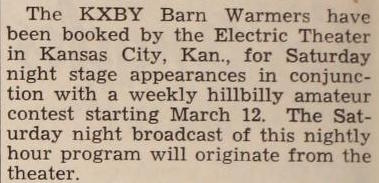
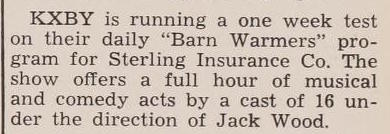
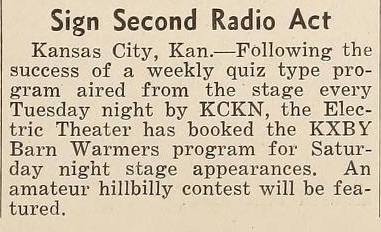
Below are three articles I’ve found about the Barn Warmers so far, all in 1938.

BarnWarmers3

BarnWarmers2

BarnWarmers1

Pioneers of the Air: African-American Kansans on Early Radio, References

1 Lynn R. Osborn, Commercial Radio in Kansas, 1908 – 1945 (Radio-Television Research, University of Kansas, 1963), 6 – 7.

2 “Work of Sumner High School,” Baltimore Afro-American, March 29, 1913, p. 7, accessed online through ProQuest Historical Newspapers Baltimore Afro-American (1893 – 1988). William W. Boone, March, 1986. “The History and Culture of Wyandotte County: A History of Black Public Education in Kansas City, KS,” 25 – 30, unpublished.

3 Rae Morgan Harris, “Over and About the City,” Topeka Plaindealer, June 2, 1922, p. 3, accessed online through Readex Online Database: African American Newspapers, 1827 – 1998. Two of the best overviews of early commercial radio are by Erik Barnouw and Tom Lewis. Erik Barnouw, A Tower in Babel: A History of Broadcasting in the United States to 1933 (NY: Oxford University Press, 1966), 61 – 124. Tom Lewis, Empire of the Air: The Men Who Made Radio (NY: Edward Burlingame Books, 1991), 160 – 179.

4 Winifred Travis, “Church Notes,” Wichita Negro Star, August 25, 1922, p. 2, accessed online through Readex Database: African American Newspapers, 1827 – 1998. “Are You Aware?” Wichita Negro Star, September 1, 1922, p. 1. “Broadcasted Over Radio,” Kansas City Advocate, May 11, 1923, p. 1, accessed online through Readex Database: African American Newspapers, 1827 – 1998. Ernest F. Jones, “Among the Churches,” Wichita Negro Star, June 29, 1923, p. 3. “Kansas Vocational School Radio Concert,” Topeka Plaindealer, May 15, 1925, p. 3.

5 “Topeka Boy Broadcasts Daily Children’s Hour Over WCCO,” Topeka Plaindealer, July 24, 1925, p. 1.

6 Ralph Matthews, “Looking at the Stars,” Baltimore Afro-American, May 21, 1932, p. 18. Earl J. Morris, “Orlando Roberson Gives Praise to His Dashing Band Maestro,” Pittsburgh Courier, June 19, 1937 p. 20, accessed online through ProQuest Historical Newspapers Pittsburgh Courier (1911 – 2002). “Robeson, Orlando [Roberson, Orlando Hurbert]” Grove Music Online accessed via Oxford Music Online.

7 Charles I. Bowen, “On the Air,” Baltimore Afro-American, May 5, 1934 p. 9. “Claude and Don On Air,” Pittsburgh Courier, December 31, 1932 p. 6.

8 “Dixie Singers are Big Radio Favorites,” Baltimore Afro-American, November 7, 1925, p. 4.

9 “Radio Notes,” Baltimore Afro-American, March 19, 1927, p. 9. “Radio Notes,” Baltimore Afro-American, April 16, 1927, p. 9.

10 “Dixie Jubilee Singers on Station WOR,” Baltimore Afro-American, August 10, 1929, p. 13. “Eva Jessye Aggregations Still in Forefront,” Baltimore Afro-American, January 25, 1930 p. 8. Richard L. Baltimore, “Radio News,” New York Amsterdam News, September 26, 1928, p. 8, accessed online through ProQuest Historical Newspapers New York Amsterdam News (1922 – 1993).

11 Richard L. Baltimore, “Radio News and Programs,” New York Amsterdam News, February 3, 1932, p. 9. Richard L. Baltimore, “Radio News and Programs,” New York Amsterdam News, February 10, 1932, p. 9. “To Broadcast Nativity,” New York Amsterdam News, December 21, 1932, p. 7. Roi Ottley, “Are You Listenin’?,” New York Amsterdam News, May 17, 1933, p. 16. Bill Chase, “All Ears,” New York Amsterdam News, March 13, 1943, p. 8. “Urban League Job Campaign Will be Aired,” New York Amsterdam News, March 20, 1943, p. 11. Raoul Abdul, “Music: Miss Eva Jessye Honored,” New York Amsterdam News, November 13, 1976, p. D16. Aileen E. Eckstein, “Wave Lengths,” Pittsburgh Courier, December 26, 1931, p. 1. Floyd J. Calvin, “Calvin’s Digest,” Pittsburgh Courier, February 27, 1932 p. 2. Aileen Eckstein, “Wave Lengths,” Pittsburgh Courier, November 5, 1932, p. 7. Billy Jones, “Stars That Shine,” Pittsburgh Courier, November 26, 1932, p. 16.

12 “Eva Jessye in Radio Play,” Baltimore Afro-American, April 22, 1933, p. 10. Charles I. Bowen, “On the Air,” Baltimore Afro-American, April 29, 1933, p. 10. Eva Jessye, “Radio Rambles,” Baltimore Afro-American, July 15, 1933, p. 10. Ottley, p. 16.

13 Eva Jessye, “Radio Revue,” Baltimore Afro-American, September 16, 1933, p. 19. Eva Jessye, “Radio Revue,” Baltimore Afro-American, November 4, 1933, p. 19. Julia Buckner, “Radio Revue,” Baltimore Afro-American, May 26, 1934, p. 8. Thomas Anderson, “Radio Review,” Baltimore Afro-American, June 30, 1934, p. 8. J. B. Brown, “Radio Rambles,” Baltimore Afro-American, August 18, 1934, p. 8.

14 Sally Bell, “On the Air,” Baltimore Afro-American, September 4, 1937, p. 11. “Loyalty of Colored America Told on Air Program,” Baltimore Afro-American, March 27, 1943, p. 10. Chase, p. 8, “Urban League,” p. 11.

15 Donald Bogle, Dorothy Dandridge (NY: Amistad, 1997), 2 – 18. Dandridge gave various accounts of her early years, muddying the historical record.

16 Estelle Edmerson, “A Descriptive Study of the American Negro in United States Professional Radio, 1922 – 1953” (Masters thesis, University of California at Los Angeles, 1954), 27 – 28. Elizabeth McLeod, The Original Amos ’n’ Andy: Freeman Gosden, Charles Correll and the 1928–1943 Radio Serial (Jefferson, NC: McFarland & Company, 2005). See McLeod’s book for a review of the various African-American performers who appeared on the show over the years.

17 Holly George-Warren, Public Cowboy No. 1: The Life and Times of Gene Autry (NY: Oxford University Press, 2007), 246. Jim Cox, The Great Radio Sitcoms (Jefferson, NC: McFarland & Company, 2007), 71 – 85. John Dunning, Encyclopedia of Old Time Radio (NY: Oxford University Press, 1998), 83, 276, 321, 377. Richard Dier, “In the Big City,” Baltimore Afro-American, October 19, 1946, p. 19.

18 Connie Billups and Arthur Pierce, Lux Presents Hollywood: A Show-by-Show History of the Lux Radio Theatre and the Lux Video Theatre, 1934 – 1957 (Jefferson, NC: McFarland & Company, 1995), 267, 286, 295, 318, 321, 326, 331, 340.

19 Edmerson, “A Descriptive Study,” 34 – 35. Bill Lane, “Funeral Services Held For Actor Roy Glenn,” The Los Angeles Sentinel, March 18, 1971, p. 1, ProQuest Historical Newspapers Los Angeles Sentinel (1934 – 2005).

20 This overview of Glenn’s most prominent radio work was compiled from a variety of sources. John C. Abbott, Yours Truly, Johnny Dollar, Volumes 1 – 3 (Duncan, OK: Bear Manor Media, 2010), 300, 315, 557 – 561, 566 – 568, 941 – 942. Martin Grams, Jr., The History of the Cavalcade of America (self-published, 1998), pages unnumbered. Martin Grams, Jr., Suspense: Twenty Years of Thrills and Chills (self-published, 1997) pages unnumbered. Martin Grams, Jr., Radio Drama: A Comprehensive Chronicle of American Network Programs, 1932 – 1962 (Jefferson, NC: McFarland & Company, 2000), 80, 116, 423, 469, 472, 475, 477, 484, 486. Billups & Pierce, Lux Radio Theater, 496, 600. Cox, Radio Sitcoms, 33. Cox, Crime Fighters, 86, 247. http://www.radiogoldindex.


Bibliography

Abbott, John C. Yours Truly, Johnny Dollar, Volumes 1 – 3. Duncan, OK: BearManor Media, 2010.

Billups, Connie and Arthur Pierce. Lux Presents Hollywood: A Show-by-Show History of the Lux Radio Theatre and the Lux Video Theatre, 1934 – 1957. Jefferson, NC: McFarland & Company, 1995.


Bogle, Donald. Dorothy Dandridge. NY: Amistad, 1997.


Boone, William W. The History and Culture of Wyandotte County: A History of Black Public Education in Kansas City, KS. March, 1986.


Cox, Jim. The Great Radio Sitcoms. Jefferson, NC: McFarland & Company, 2007.


Radio Crime Fighters: Over 300 Programs from the Golden Age. Jefferson, NC: McFarland & Company, 2002.


Dunning, John. On the Air: The Encyclopedia of Old-Time Radio. NY: Oxford University Press, 1998.


Edmerson, Estelle. “A Descriptive Study of the American Negro in United States Professional Radio, 1922 – 1953.” Masters thesis, University of California at Los Angeles, 1954.


George-Warren, Holly. Public Cowboy No. 1: The Life and Times of Gene Autry. NY: Oxford University Press, 2007.


Grams, Martin, Jr. The History of the Cavalcade of America. 1998.


Suspense: Twenty Years of Thrills and Chills. 1997.


Radio Drama: A Comprehensive Chronicle of American Network Programs, 1932 – 1962. Jefferson,

NC: McFarland & Company, 2000.


McLeod, Elizabeth. The Original Amos ‘n’ Andy: Freeman Gosden, Charles Correll and the 1928 – 1943 Radio Serial. Jefferson, NC: McFarland & Company, 2005.


Osborn, Lynn R. “Commercial Radio in Kansas, 1908 – 1945.” Radio-Television Research, University of Kansas, 1963 (unpublished).

Pioneers of the Air: African-American Kansans on Early Radio, Pt. 8

Like his contemporary Ruby Dandridge, Roy Glenn was both a Kansas native and prolific actor on network radio during the 1940s and 1950s. Glenn was born June 3, 1914 in Pittsburgh, KS, but his family moved to Los Angeles when he was six. He was cast in various stage performances during the 1930s and in later years claimed that he made his first radio appearances during this time as well, starring on the bi-racial The Gilmore Gasoline Show in 1936. Records indicate this was his only work on the medium until 1946 when he earned a part on The Amos ‘n’ Andy Show. He was one of several black radio actors that was cast on this show and, later, Beulah. There is no evidence that Glenn ever had long-running roles as did Ruby Dandridge. However, as a journeyman actor he is credited with parts on some of old time radio’s most popular and fondly remembered series.19

Glenn’s radio-ography is headlined by guest appearances on The Jack Benny Show, a perennially top-rated radio comedy program during the 1940s and early 1950s. He earned spots on eight broadcasts of Suspense, a weekly anthology series which ran from 1942 until 1962 and attracted Hollywood headliners for the lead parts. No less impressive are seven appearances on Yours Truly, Johnny Dollar, a private-eye program which aired between 1949 and 1962. He joined Cary Grant on a broadcast of the marquee series Lux Radio Theatre. Mystery shows were a good fit for Glenn’s voice talents and, in addition to Johnny Dollar, he was cast at times in Richard Diamond, Private Detective (1949 – 1953), which featured Dick Powell in the title role, and in The Adventures of Ellery Queen (1947 – 1948). Glenn’s resume could also boast of appearances on Pete Kelly’s Blues, featuring Jack Webb of Dragnet fame (1951), Crime Classics (1953 – 1954), and Rocky Jordan (1945 – 1947), co-written, incidentally, by Gomer Cool who broke into radio on Kansas City’s KMBC. During the heyday of Glenn’s radio work from the mid 1940s to the mid 1950s his talent landed him on individual episodes of the police show Broadway is My Beat (1949 – 1954), Tales of the Texas Rangers, a western, (1950 – 1952), the experimental CBS Radio Workshop (1956 – 1957), Romance (1943 – 1957), and Hallmark Hall of Fame (1948 – 1953).20

With the demise of dramatic radio in the early 1960s Glenn transitioned to television and continued with film roles, his most prominent parts coming in Guess Who’s Coming to Dinner and A Raisin in the Sun. He died prematurely of a heart attack in 1971 at the age of 56.

Kansas may not be able to claim the radio heritage of states such as New York or California, but the early accomplishments of African-American Kansans in the field are an area in which the state may be proud. From the efforts of Sumner High School staff to get students engaged in the emerging wireless technology to George Hamilton’s daily broadcasts in 1925 to the dramatic roles of Roy Glenn in the mid-1950s, black Kansans had a steady presence on the nation’s airwaves.

Pioneers of the Air: African-American Kansans on Early Radio, Pt. 7

Black radio actresses frequently portrayed domestic servants on network radio and Dandridge found stead employment in such roles. She can be credited with playing at least four different aural maids and cooks. The first was that of Geranium, an overweight maid on The Judy Canova Show. The series starred Judy Canova, a white actress who had created a female hillbilly persona, and entertained listeners for ten years from 1943 to 1953. Geranium was Dandridge’s first long-term radio role and the next year she accepted the part of Mammy Brown, a similar part on The Gallant Heart, an NBC soap opera which ran during 1944. While providing steady income, such demeaning characters provided ammunition for black critics who were increasingly irritated by the servile roles to which so many black radio artists seemed relegated. In 1946 Afro-American writer Richard Dier slighted the part of Geranium as an “Uncle Tom maid.” If Dandridge had reservations about such roles it didn’t affect her career choices as she began starring as Oriole, a maid on The Beulah Show. Beulah, portrayed over the years by white actors Marlin Hurt and Bob Corley and then black actresses Hattie McDaniel, Lillian Randolph, and Amanda Randolph, was a maid herself. Dandridge played Oriole the entire run of the series, from 1947 until 1954. Yet another similar part came her way in 1949 on The Gene Autry Melody Ranch. This role was Raindrop, a “Rochester-meets Aunt Jemima” character according to Autry historian Holly George-Warren.17

Dandridge never achieved her own program, a rare feat for any African-American during this era, but it wasn’t for lack of talent. The producers of Lux Radio Theater, one of the most prestigious radio programs of the era which adapted popular Hollywood films for the air between 1934 and 1955, cast her on eight different episodes between 1941 and 1945. More often, however, she had to settle for guest appearances on the programs of several white celebrities, including The Hoagy Carmichael Show, Bing Crosby’s Philco Radio Time, and The Jimmy Durante Show.18

Financial security is not a luxury afforded to many actors and despite Dandridge’s years of steady network employment, she couldn’t retire when performing opportunities dried up in the early 1950s. Beginning in 1954 she went to work as an agent for Dorothy Foster Real Estate in Los Angeles. This second career lasted until at least 1960. Tragedy struck in 1965 when her famous daughter Dorothy died unexpectedly. Ruby herself passed away in 1987, her ten-year network radio career all but forgotten.

Pioneers of the Air: African-American Kansans on Early Radio, Pt. 6

Though Jessye’s prime radio years during the medium’s Golden Age were over by World War II, she continued to lead the Eva Jessye Choir for years to come and later made some film appearances. Jessye continued to be engaged in musical endeavors during her later years and in the 1970s and early 1980s she was associated with the University of Michigan and Pittsburgh State University in Kansas. She died in 1992.

The most famous of Kansas’ Golden Age radio actors might Ruby Dandridge, the mother of Vivian and Dorothy Dandridge, the latter of whom made a considerable name for herself in film. Her birthplace varies depending on the source but the most authoritative, Dandridge historian Donald Bogle, provides convincing evidence that she was born in Wichita, KS, on March 1, 1899. Sometime around her twentieth birthday Dandridge moved to Cleveland, OH, to escape the limitations she felt in central Kansas. In Cleveland she married Cyril Dandridge and gave birth to both daughters. The marriage would not last, nor would her satisfaction with Cleveland. With the onset of the Great Depression Dandridge, her friend Geneva Williams, and Dorothy and Vivian headed west and settled in Los Angeles where African-Americans were finding parts in motion pictures.15

Dandridge claimed in the early 1950s to have started on radio with the WPA during the 1930s but supporting evidence for this assertion has not yet been discovered. She did do considerable stage work in the Los Angeles area during the 1930s and it’s possible some of the productions were broadcast. The first and most popular radio series on which she was hired was The Amos ‘n’ Andy Show, a comedy which debuted in 1928 and featured two white men – Freeman Gosden and Charles Correll – as two African-American men in Harlem. During the 1940s the radio program included numerous black performers in addition to Dandridge, including Ernest Whitman, Hattie McDaniel, and Amanda Randolph.16

Pioneers of the Air: African-American Kansans on Early Radio, Pt. 5

The onset of the Great Depression did not hurt Jessye’s radio opportunities. Though Aunt Mandy’s Children left the air in 1930, the choir continued to make multiple appearances in 1931 and 1932 on NBC. These broadcasts include a December 29, 1931, concert and a special Lincoln Day program on February 12, 1932. Jessye’s choir sang over several Sundays during the fall of 1932 in addition to holiday broadcasts on Thanksgiving Day and Christmas Day. The Christmas feature included a nativity dramatization which starred Frank Wilson, one of the busiest African-American stage and radio actors of the era.11

For a change of pace Jessye took an acting role in April, 1933, on a comedy-drama called The Townsend Murder Mystery which aired on NBC. This Octavus Roy Cohen-penned series also featured African-American actors Frank Wilson, Ernest Whitman, and Tim Moore. Cast as the character Magnesia, Jessye did not become a regular on the program (which only aired a few months), nor did she become involved in other dramatic radio programming.12

During the last months of 1933 and into 1934 Eva Jessye and her choir made most of the rest of their known radio broadcasts. These appearances included A Tribute to Negro Soldiers, July 4, 1933, The Capitol Theatre Family, November 5, 1933, and a weekly Sunday afternoon program of spirituals and quiet philosophy, all on NBC. During 1934 Jessye’s singers were guests on the Hudson Motor Company’s Terraplane Travelcade in May and again on The Capital Theatre Family with Etta Moten and Bob Hope later in the year. A notable performance came on July 8 when the choir broadcast to Russia alongside radio singers Eva Taylor and the Southernaires.13

Two broadcasts from later years are known, one from 1937 and another from 1943. On August 31, 1937, Jessye’s choir were guests on Ben Bernie’s show which was sponsored by the American Can Company. In the 1940s, when black programming was increasing, the choir provided music for the National Urban League’s March 20, 1943 episode of Heroines in Bronze, a series on WABC.14