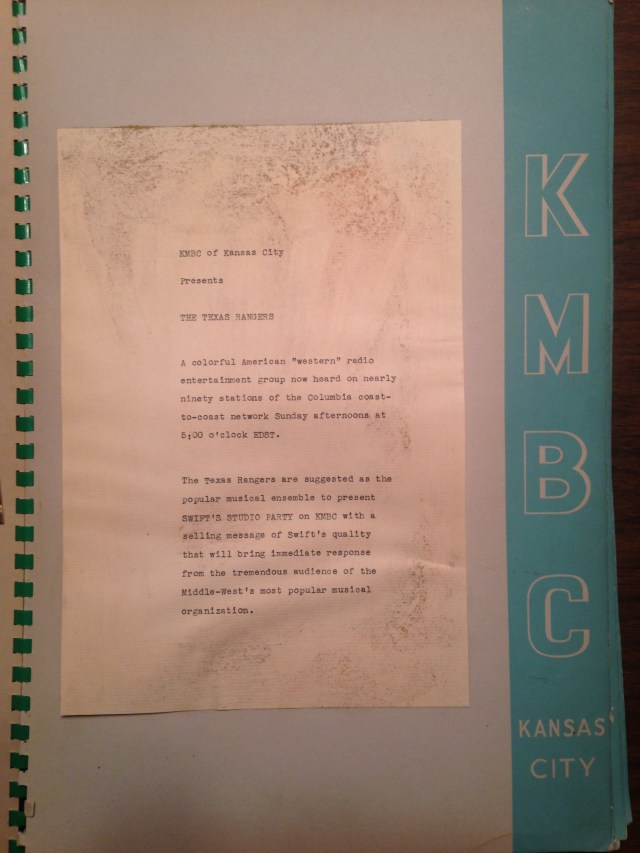
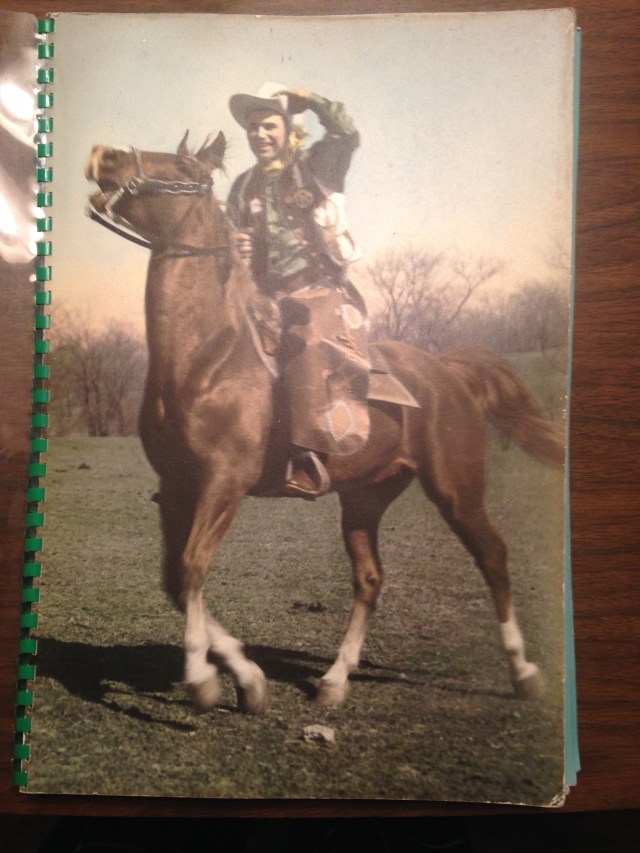
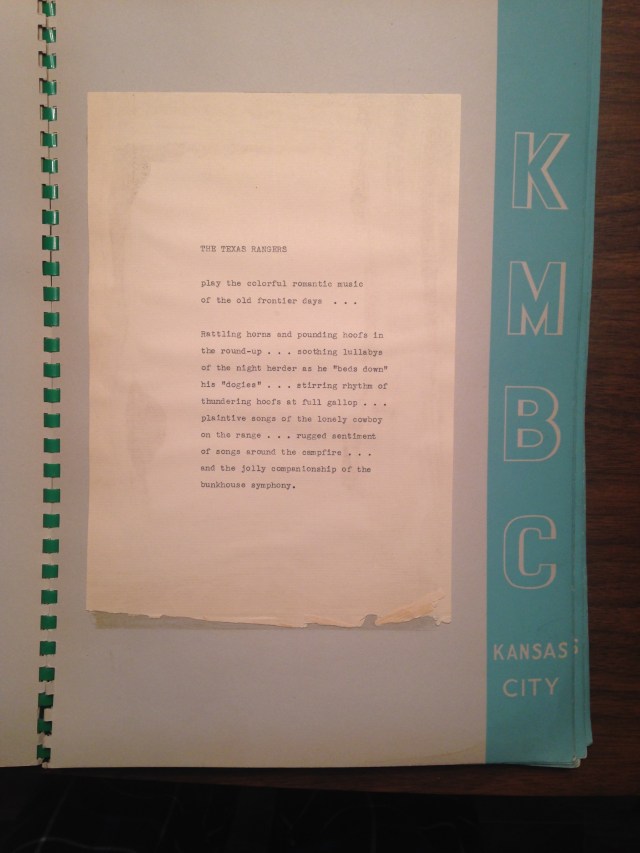
Texas Rangers Promotional Portfolio pg. 4

As mentioned in the Texas Rangers book, none of the original Rangers musicians were actually country – or hillbilly, as the genre was frequently called at the time – musicians. Accordianist Paul Sells had had his own nightclub orchestra and fiddler Gomer Cool was classically trained. They practiced a lot to get a more Western sound but their repertoire over the years was very diverse, with ballads, spirituals, hymns, folk, and even patriotic tunes finding a spot in their recorded catalog.

IMG_4537

Texas Rangers Promotional Portfolio

I am always on the lookout for memorabilia for Kansas City’s KMBC from the Arthur B. Church era, 1920s to about 1953 when he sold it. I was beyond thrilled to win this item on Ebay earlier this year. Some background on this item. The University of Missour – Kansas City has some of the Arthur B. Church KMBC archival material. In their collection are six of these oversize promotional portfolios for different series and artists that the station tried to sell on a transcription basis with mixed results. You can view scans of these portfolios here on the left-hand side of the page.

This is a seventh portfolio that is different from those in the UMKC collection though its content is the Texas Rangers who are also the featured content of the two above-linked portfolios “Gentlemen in the White Hats” and “Life on the Red Horse Ranch.”

These portfolios appear to each be unique items created by KMBC ca. 1940. Each one contains photographs, telegrams, letters, and blown up copies of trade magazine reviews. As you can see, these items are all glued to the pages so each portfolio appears to be a prototype that would then be copied and distributed to potential sponsors. In years of looking through different KMBC archives I have never seen a replica of these portfolios so I suspect either they never moved beyond the prototype phase or they were only used for in-person promotions. They are in such good condition, however, that I can’t imagine they were handled much.

Because of the location of this item’s seller I believe this portfolio likely came from the Arthur B. Church family at some point; why it was not donated with the other materials is unknown.

There is no new information in this piece that is not in my book on the Texas Rangers but the pictures sure would have been a priceless addition to it. At least they can be viewed here, better late than never.

Here is the cover; I can’t tell which member of the band that might be.

IMG_4534

The Radio Career of Carlton Moss, pt. 7

Moss was suspicious of radio by the time of that interview (early 1950s), seeing it both as a path to financial success for African-Americans and a tool by which white America could perpetuate racial inequality. Surely his experience with Folks From Dixie, a show he was pressured by the network to write as a comedy despite more personal interest in serious themes, reinforced this view of radio

For Moss, radio was never purely about money, though a certain level of compensation was certainly necessary for him to continue in the field. In the bigger picture he viewed radio as a potential avenue for black empowerment that was being blocked by the white-owned and operated networks. He insisted that radio would not change on its own; what was needed was nothing less than government intervention in the form of the Fair Employment Practice Commission forcing open these opportunities. “If given a chance, this Negro could make a great contribution to that field” he emphatically insisted. As with so many industries and career fields, “lack of opportunity is the problem.”

One second-hand account of Moss during his radio years survives in the work of John Houseman, with whom Moss worked at the WPA’s Negro Theater Unit in the 1930s. Looking back on that job years later, Houseman wrote briefly about Moss and provided a bit of further insight into his persona: “When [Moss] came to work for the WPA at the age of twenty-five, he was already a bitter and skeptical man. But behind his smiling pose of self-protective sarcasm lay a deep and sympathetic understanding of the inner workings of the Negro world.”

What little information concerning Moss’ radio work which has survived points to a commitment to using his writing to empower and uplift African-Americans, though not in any idealized manner. His stage work, both with community groups and with the WPA during the same time lends further support to asserting that his emphasis on racial awareness and empowerment did not only develop later in life during his film career. In the mid-30s Moss took a position with the Negro Theater Unit of the Federal Theater sometime in 1935, a program intended to put unemployed writers to work. There he worked under the aforementioned Houseman, a white man who was chosen to co-lead the Unit with accomplished African-American actress Rose McClendon (featured frequently in Moss’ radio productions). McClendon passed away soon after the creation of the jobs program and Moss was one of three African-Americans that took charge of the Negro Theater Project when Houseman later left to work on a more classical theater project.

Later, Moss worked with the Negro unit of the New York Project of the Federal Writers Project (FWP). His exact role is unclear but Jerre Mangione, national coordinating editor of the Project, points out that Moss’ name was included on a list of editors found among FWP documents that were eventually published as The Negro in New York (1967). Also on the list were such luminaries as Ralph Ellison and Claude McKay. Other stage work during his years in New York included original scripts for plays including “Sacrifice” and an untitled work about black history. Further projects brought him in contact with black artists outside the writers’ circles including Aaron Douglas, for whom Moss wrote a play to celebrate the unveiling of the painter’s work at Harlem’s West 135th St. branch library, as well as William Grant Steel, for whom he wrote the libretto for the opera Blue Steel.

The company Moss kept during his years in New York also lends credence to an assumption that his radio work was just as concerned with black pride and empowerment as was his theater and film work. Beyond the figures mentioned above, Moss recounted his days in Harlem and interactions with such luminaries as James Weldon Johnson and Langston Hughes in regards to film-maker Oscar Micheaux. According to Odette Harper Hines, Moss very close with Ralph Ellison in the mid-30s due to their collaboration on the Federal Writers Project. Recognizing the significance of the artists with whom he mingled in the 30s, by the mid-40s Moss was lecturing publicly on Paul Lawrence Dunbar, Zora Neal Hurston, Hughes, Johnson, Phyllis Wheatley, and Richard Wright.

Despite his pioneering work in radio, Carlton Moss’ influence on radio appears to have been minimal in the long run. While he opened the door to black opportunity on the air, few seemed to take advantage of his inroads. The performers in his unofficial acting troupe who were featured on so many of his network broadcasts did not go on to any notable radio careers. Outside of the musical success of the Southernaires, none of the performers even went on to appear in any mainstream network programming on a regular basis. Interestingly, Edna Thomas, Richard Huey, and Frank Wilson appeared on an episode of Cavalcade of America (December 25, 1940) sponsored by the DuPont company on NBC’s Red network. The broadcast was an adaption of Marc Connelly’s play “The Green Pastures,” focusing on black Southern Christianity.

None of the small numbers of African-Americans who did find notable success in radio later in the ‘30s and through the ‘40s and ‘50s, including Eddie Anderson (Rochester on The Jack Benny Program), Lillian Randolph (Birdie on The Great Gildersleeve), Hattie McDaniel (Beulah), and Wonderful Smith (Red Skelton Show), have left any indication that Moss, his programs, or his cadre of pioneering black performers influenced their careers.

If any later radio work can be attributed to Moss’ influence, the best candidates would be the broadcasts based on Roi Ottley’s 1943 book A New World A Comin’. In the late 1940s his book was adapted to radio and became one of the most prominent black series during the heyday of radio drama. As noted above, Ottley covered Moss’ radio work while on staff for the Amsterdam News during the early ’30s, then later worked with him on the Federal Writers Project. Ottley’s reviews of Moss’ work were generally positive and it is reasonable to surmise that these works had some influence on Ottley when he set about turning his book into aural productions.

In retrospect, Moss’ work should be viewed both within the longer thread of black radio that flowered briefly in the late 20s and later bloomed in the 40s and as a unique broadcasting contribution that stands without peer in the annals of black radio. There can be little question that Floyd Calvin, Jack Cooper, and the unknown staff at WABC paved the way for black programming on radio through their efforts at the end of the 1920s. At the same time, the scope of Moss’ work in content and audience reception is incomparable. No other African-American was writing drama, or even comedy beyond short sketches, for black audiences using black performers. Further, no other African-American beyond the most popular jazz performers were getting airtime on NBC’s nationwide network, the premier radio vehicle of the era. In this respect the efforts of Carlton Moss to bring black art to radio were wildly successful; that more African-American programs were not aired in the wake of his efforts is to the discredit of the radio networks. That the historic contributions Moss made to black performing arts – notably radio – have been entirely overlooked for three-quarters of a century is to the discredit of a wider society often little interested in the contributions of is African-American members.

“Negro Actor Plays White Role on ‘D.A.'”

Such a turn of events elicited this piece in a July 19, 1944, issue of Variety magazine. Of course, white performers had been portraying African Americans since the birth of broadcasting but this was quite the anomaly. Maurice Ellis, a gifted actor, is profiled in my book on black radio performers. Mr. District Attorney was a very popular radio program from 1939 – 1952. Notice that the “regular” role is de facto for a white person. And here’s a link to an article about the man who may be the actual first black forest ranger.

Black Forest ranger 07-19-1944

The Radio Career of Carlton Moss, pt. 6

In 1934, before Meetin’ House hit the airwaves, Moss penned what may have been the first and only African-American radio mystery. Details, as with so many of his other works, are sparse. It aired on WMCA, September 15, 1934, as part of an Americana program. Rose McClendon, Frank Wilson, and Richard Huey, all familiar names from prior Moss productions, were the featured cast. Regular musical talent the Southernaires did not participate, however; instead music was provided by Alson Burleight’s choir. A Baltimore Afro-American critic indicated a lukewarm reception: “Some say ‘twas good in spots, still others say that the ‘spots’ were few and far between. Twas middlin, but promising in several respects.”

Other one-time assignments during 1934 and 1935 include a sketch for NBC that presented a look at the history of the Alpha Kappa Alpha sorority as well as his first commissioned work for the YMCA. For this October 1935, broadcast Moss wrote “Negro Achievement,” a half-hour presentation hosted by James S. Watson, New York City’s first African American judge. This YMCA Founder’s Day broadcast “depict[ed] the high spot in the lives of five outstanding Negroes.” Frank Wilson, a familiar voice from earlier Moss work, appeared in the show.

Three years later Moss was again called on to recognize the YMCA. He penned a dramatized tribute celebrating the fiftieth anniversary “of YMCA’s serving the colored youth . . . The play will depict the growth and present needs of the Y’s work with colored youths.” This tribute was broadcast over WOR (New York) and the Mutual Broadcasting System on November 6, 1938. Entitled “Into the Light,” the production featured Rex Ingraham and, once again, Frank Wilson.

Sources connect Moss to at least two other radio efforts during his years in New York, neither of which are corroborated elsewhere. Estelle Edmerson, in her review of African Americans in radio, relates that Moss told her of radio work he did for WMCA in New York. Unfortunately he did not provide any details of this work other than the material was dramatic in nature and featured “a concentration of Negro performers and materials on the Negro.” Unlike his earlier work, white performers were also used. Is it possible Moss was referring to his dramatic works featured on WEAF and WJZ? It wouldn’t be the only error Moss made in recalling his radio days with Edmerson. He also related to her that be began in radio in 1931 when in fact it was early 1930.

One final radio credit comes from media historian William Barlow, who makes mention of The Negro Hour and credits its production to Moss sometime in 1928. It’s unlikely this refers to the All Negro Hour (aired from Chicago) as there’s no evidence Moss visited that city for professional radio work. Possibly it refers to the Courier Hour or WABC’s Negro Achievement Hour but it does not appear that either series was still on the air in by 1930 when his first confirmed radio works were written. No mention of a Moss connection to any of the three pioneering shows discussed above in 1928 or at any other time has been discovered in the African-American press of the time, casting doubts on Barlow’s claim.

By 1943 Moss had relocated to Los Angeles. Though his career turned to film, he had a handful of radio ventures left ahead of him. In 1944 he penned two war-related stories. The first was “The Negro Soldier from Bunker Hill to Guadalcanal,” a patriotic drama for CBS which aired in February. This was followed in March by a dramatization of black soldier Private Marsh who was a Silver Star recipient for rescuing twelve men behind enemy lines. The following year, 1945, he hosted a fifteen-minute show dubbed Carlton Moss Reports that brought “listeners news not usually heard elsewhere – adequate and objective coverage on all minority activities.” Sponsored by sportswear apparel maker Louis Tabak, Carlton Moss Reports initially aired Sunday afternoons at 1:30, beginning September 29, 1945 on KFWB. It ran for at least one year. After this final community-oriented series, it seems that Moss finally put radio behind him and focused entirely on film. He spent the latter half of his life making films and teaching at two universities, Fisk University and University of California-Irvine.

Until more primary documents concerning Moss’ radio work turn up, modern scholars can only infer the political and philosophical approaches represented in these radio works. A meager two firsthand accounts left by Moss concerning radio have so far been uncovered. The earliest is his comments on the theme of Folks From Dixie, discussed above. The second, and perhaps more encompassing, was recorded by Edmerson. In response to her questioning, Moss gave three reasons for getting out of radio. First, he was “disheartened by the ridiculous manner in which radio presented the Negro.” Second, his programs never found sponsorship, which he attributed to prejudice against African Americans. Third, he wanted his work to be more than just amusement: “All art does something. My concentration has been to do material to inspire Negro people. There is much of it in the realm of entertainment. Probably in the last ten years, I could have made myself some money in radio but I can’t kid myself into thinking radio is just entertainment. All American radio takes it [sic] cue from the official government. We are automatically under a jim crow set-up.”

Meetin’ House Broadcast Log

This is an initial broadcast log of Carlton Moss’ Meetin’ House based on newspaper schedules. It may be the most accurate log we can compile until NBC documentation is unearthed providing all the official broadcast dates and times.

Meetin’ House

Tuesday 10:30 – 11:00 WJZ

4/9/35

Friday 10:00 – 10:30

5/24/35

5/31/35

6/7/35

6/21/35

6/28/35

7/19/35

7/26/35

8/2/35

8/9/35

Friday 10:30 – 11:00

8/16/35

8/23/35

Friday 10:00 – 10:30

9/6/35

9/20/35

9/27/35

10/4/35

10/18/35

Tuesday 3:15 – 3:45

12/3/35

12/10/35

12/17/35

12/31/35

1/7/36

1/14/36

1/21/36

2/4/36

2/11/36

2/18/36

2/25/36

Tuesday 5:00 – 5:30

3/10/36

Tuesday 4:45 – 5:00

3/24/36

Tuesday 5:00 – 5:30

4/7/36

4/14/36

4/21/36

4/28/36

5/12/36

5/19/36

5/26/36

6/2/36

6/9/36

6/16/36

Tuesday 9:30 – 10:00

8/25/36


Wednesday 11:30 – 12:00 pm WEAF

3/3/37

3/10/37

3/17/37

3/24/37

3/31/37

The Radio Career of Carlton Moss, pt. 5

Carlton Moss’ final radio series and the second with dramatic content was Meetin’ House, a half hour program that premiered December 24, 1934, at 11 pm on WJZ. New York Times radio schedules indicate Meetin’ House aired for over a year and a half, finally leaving the airwaves on August 25, 1936, after a run comparable in length to Careless Love. Like his debut series, Meetin’ House was the victim of numerous schedule changes, ranging in time from mid-afternoon to late night and on various days of the week. Several months into the run of Meetin’ House, Carlton Moss married Annie L. Savage on July 19, 1935. Perhaps this change in his personal circumstances affected the stability of the young program, leading to the erratic broadcasting times. Schedules further indicate lapses of sometimes multiple weeks between episodes.

While August 25, 1936, appears to be the final regular episode, one minor newspaper, the Poughkeepsie Eagle-News, lists a five-week run of the series in May 1937, over WEAF. Whether these broadcasts used new scripts, re-aired old scripts, or were transcription re-runs cannot be ascertained from the available records. This is the only clue so far to hint that at least some of Moss’ work was recorded, thus preserving the unlikely possibility that samples of his radio work could be discovered in the future.

Performers on this third production included veterans Frank Wilson, Georgia Burke, Laura Bowman, Eva Taylor and the Southernaires along with Isabelle Washington Powell. Some reviews from the New York Amsterdam News, provide our only glimpse into the show’s premise. Like Moss’ prior works the story was centered in the South, this time featuring weekly installments of the adventures of a circuit preacher to the NBC network. It also followed the example of Folks From Dixie and featured at least one recurring character as opposed to using an anthology format similar to his debut effort, Careless Love. Roi Ottley’s reviews were ambiguous at best, hostile at worst. Across two of his “Hectic Harlem” columns he claimed Moss “deserve[d] … sustained and sincere applause for his outstanding work in the field of radio drama” and that he was “the outstanding author of radio script of the race [sic].” Not long after, however, he goes on to blast Meetin’ House as “dull and uninteresting entertainment” with a weak lead character (the preacher). That the series was dramatic in nature is confirmed by at least two other sources which describe Meetin’ House as a drama.

These three series (Careless Love, Folks From Dixie, and Meetin’ House), aired between 1930 and 1936, represent the bulk of Carlton Moss’ literary radio work, but it is far from the entirety of his aural writing. More non-dramatic series and dramatic one-shots can be attributed to his pen.

The first was his project with WEVD in early 1930, mentioned above. In early 1932, as Careless Love approached the end of its run, Moss seemed to have been involved in another ongoing series entitled Slow River, which also featured several players from Careless Love. One source indicates Slow River was broadcast over WABC on Mondays at 5:45 as of January 7, 1932. A review of New York Times radio schedules from this time period, however, indicates that time slot was held by Lone Wolf Tribe, a children’s show. The series does show up in radio logs by March on WJZ at 4:15. Sparse descriptions in the Times simply say “Negro Quartet and Eva Taylor.” A bit more illuminating is a brief write-up in the Pittsburgh Courier: “The ‘Slow River’ feature, heard weekly, starring Eva Taylor, Carlton Moss, Wilson and Georgia Burke, as well as the Southernaires quartet and the Levee Band became a permanent hour on the radio.” In early 1932 this would have been a second weekly writing assignment on top of Careless Love, a task not uncommon in radio annals. Further evidence against giving Moss writing credit for the program is a newspaper note that states “’Slow River’ . . . includes descriptive southern ballads and plantation songs.” No mention is made of dramatic or comedic sketches which characterize Moss’ other work. One contrary piece of information comes from the Baltimore Afro-American which does, however, give Moss writing credit for Slow River. Perhaps he was involved with writing banter in between the featured musical numbers. Even so this would not be considered dramatic work in the vein of the three series above. Nevertheless, these scattered references seem to confirm that Moss had a role with this fourth ongoing production

Later in 1932 Moss hosted a weekly series sponsored by the University Scholarship Foundation, of which he served as the chairman of the foundation’s executive committee. This hour long program was broadcast over local New York station WEVD from eight to nine in the evening. This series may have been billed The Negro Forum Hour based on an early 1933 newspaper announcement of a Moss radio effort. It may have also been called Community Forum, a series credited to Moss by another source. If these sources all refer to the same series, the focus was, in part, on New York celebrities. This is at least the second on-air assignment Moss had with WEVD, assuming this forum differed from the Intercollegiate program aired in early 1930. One source states as of January, 1932, Moss was the director of programs for the station, a post he held for an undetermined length of time.