George Frame Brown and His Real Folks, Pt. 7

This article originally appeared in Radiogram, January 2016.

Without any known recordings of Real Folks, the closest we can currently get to hearing that classic series is a partial re-enactment broadcast on the November 17, 1940 Behind the Mike. The episode can be found online at different sites (http://ia802502.us.archive.org/13/items/Behind_The_Mike/Behind_The_Mike_40-11-17_ep09_Making_A_Living_By_Dying.mp3) and the Real Folks segment begins about ten minutes in. In it George Frame Brown, Elsie Mae Gordon, Irene Hibbard, and Edwin Whitney gathered to reprise their roles. We can also get a sense of the show through contemporary accounts and some continuity that was reprinted in one radio publication of the era. Various story lines focused on the discovery of oil, starting a newspaper, graduation, a talent show for the local orphanage, knitting contests, and adoptions. A portion of the one known script excerpt is included below:

Elmer: Eleven goes in 78 – seven times and one to carry –

(Prince whines and scratches at the door.)

Elmer: Hello Prince, old boy, what’s the matter? You want out? All right, I’ll let you out, old boy. Betcha smell a rat, huh?

Matt: He Elmer!

Elmer: Yes, Uncle Matt.

Matt: Where you goin’?

Elmer: Prince wants out –

Matt: You sit down there and finish your homework – I don’t want to see any such report card as you brought home this week.

Elmer: But gee, Uncle Matt, he’s scratchin’ and beggin’.

Matt: He’s beggin’ for one of them peppermints you’re nibblin’ on.

***

Elmer: Come on Prince.

(Prince barks)

Martha: Here, Matt, I got another kerosene lamp fixed.

Matt: Thanks, Marthy, I’ll just put this one over near the potato bin. My golly, it seems funny dependin’ on these old kerosene oil lamps after spoilin’ ourselves so long with electricity.

Martha: If you ask me, I still think they’re as good as bulbs.

Matt: That’s a fine way for you to talk – and me president of the light and power company. It’s a lucky thing we got the mail out before the fuses blew –

Martha: I thought there’d be more folks in askin’ for their mail. I guess maybe it’s too cold.

(Door slams)

Martha: That sounded like the front door.

Matt: Who is it?

Bill: It’s Bill Perkins. I brought some company over from the station.

Matt: Come on in and get warm.

***

Mitchel: Ah, I do not sell my work, but rather offer it for approval. I have known the acclaim of the crowned heads on the continent, I have been the guest of governors, municipal dignitaries, and scions of the country’s oldest families. My name and picture have been posted in all the great cities to awaken the anticipation of a grateful multitude.

Matt: Did you ever play on Broadway in New York?

Mitchel: New York! Bah! Illiterate boors with no taste or cultivation. A great artist could perish in the street without a second look. No, not in New York, but my career – my career … my … my career … a … a … a … has taken me to every important city … my … my … greatness … has …

(Voice fades – sound of body falling.)

Martha: Oh, gracious! What’s happened?

Matt: Sh-sh-sh … I guess he’s fainted. I can’t see his face in this light. Marthy, go in and make some strong coffee and warm some hot broth. I think I know what’s the matter.

By 1931 Real Folks had moved to WABC where it was broadcast over the CBS network with a new sponsor, Log Cabin Syrup. Brown hoped that the move to Sunday afternoon that came with the station change would restore the series’ children audience, many of whom had stopped listening as Real Folks had earlier settled into evening time slots.

By the next year, 1932, and four years after Real Folks had debuted, the program was running out of gas. Whether the quality had declined or the sophistication of radio listeners had simply passed it by, a Variety reviewer found little to like. The reviewer noted that motion pictures had left behind the rural sketches but radio was slow to catch on to that trend. He also indicated that the 30-minute length was too much compared to the quarter-hour length of similar shows. While nothing was overly poor about Real Folks, there was simply nothing out of the ordinary about the broadcast. As best can be determined, Real Folks left the air in the first quarter of 1932.

For the next few months Post Toasties sponsored George Frame Brown in a series of personal appearances during which he performed monologs with some of the radio show’s characters. Later in 1932 H. Emerson Yorke, who had previously worked for Paramount Long Island as a casting director before moving into radio production, filmed a trailer of Real Folks with members of the radio cast that was used to promote Brown’s personal appearances.

Brown’s one-man show was re-conceptualized as a full-cast stage version of radio’s Real Folks and it transitioned to the Broadway stage in fall of 1932. Brown headed the cast, with Virginia Farmer, Irene Hubbard, and Phoebe Mackay continuing from the airwaves and new actors George Usher, George Shields, Earl Redding, Flavis Arcaro, Gene Cleveland, Edward D’Oisy, Sam Monroe, Phillip Robinson, Norman Williams, and Elizabeth Erich joining them.

The play was renamed “Thompkins Corners” and a cross-country tour was scheduled to begin September 26, 1932. Audience enthusiasm for Brown’s creation had indeed dimmed, and after four weeks playing town halls and auditoriums the show folded in Syracuse. NBC had to step in and ensure that the actors got their promised pay. Interestingly, though it was the most publicized stage version of Real Folks, it wasn’t the first. Back in 1929 Brown had performed some Real Folks sketches on the Keith’s vaudeville circuit.
George Frame Brown and His Real Folks, Pt. 6

This article originally appeared in Radiogram, January 2016.

            Real Folks announcer, Alwyn Bach, was an award-winning speaker with a lengthy history in radio even by the late 1920s. Bach was born to a Danish mother that he felt contrasted with his 6’ 2” frame accented by dark hair and eyes and olive complexion. Bach had very distinct childhood memories of his mother poring over a dictionary and pronouncing words at all times, even while stirring soup on the stove. She insisted on perfection diction from her son, admonishing him “Alwyn, I’m ashamed of you. For heaven’s sake, use your lips.” At 16 Bach began formally studying singing and within a year he was conducting a 32-voice chorus in a local church and singing in the choir of a second church. Bach also directed a number of musical productions.

As a young man Bach served in World War I with the 44th Coast Artillery Corps and saw action on the Somme-St. Mihiel front. After the war he went into the printing business and he learned the ins and outs of English grammar. Bach claimed he got into radio in October 1922 announcing for Springfield, MA’s WBZ where he announced the Boston Symphony broadcasts. A humorous episode in which Bach was involved happened in 1924 at the Democratic Convention in New York City.

Recognizing that the nomination process was going to extend well into the night Bach decided to freshen up and take a bath at 2:00 in the morning. Without warning just as Bach had lathered up in his hotel tub, the WBZ engineer burst in on him, microphone in hand, and Bach began broadcasting the latest updates without hesitation. Bach’s intuition was correct; the convention would be the longest nominating process in election history.

In 1926 Bach moved to sister station WBZA in Boston and then to NBC in 1927. By 1930, after Real Folks had been on the air two years, Bach was announcing a number of shows including The Davey Hour, The Hour With Shakespeare, Reminscences, Around the World with Libby, Enna Jettick Song Birds, Famous Loves, and shows sponsored by Iodent, Enna Jettick Shoes, Beacon Oil, and Natural Bridge Shoes. That same year Bach won the Medal for Good Diction given by the American Academy of Arts and Letters, an award that would be won over the years by such notables as Edward R. Murrow (1957), Garrison Keillor (1990), and President Bill Clinton (2004).

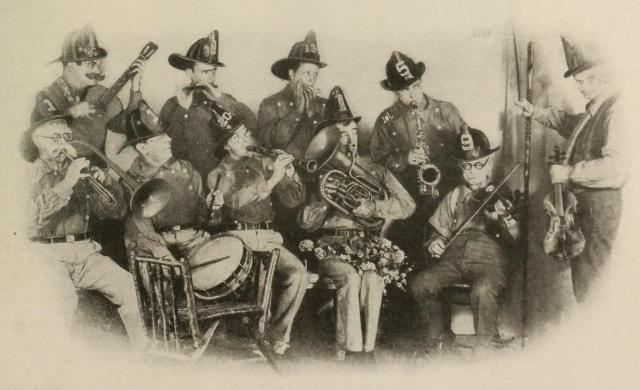
Real Folks was produced and directed by none other than Raymond Knight who had joined NBC in 1928. He was behind a number of the network’s programs in 1929 such as The Gold Spot Pals, Embarrassing Moments in History, Hello, Mars! Triadamas, Empire Builders, and most famous of all, Station KUKU, also known as The Cuckoo Hour. NBC music director Harry Salter was in charge of the series musical background. He wrote the music and led the Thompkins Corners Firemen’s Band and also the Ladies’ Augmented Orchestra. The Firemen were noted for playing all their songs just a step out of tune.

George Frame Brown and His Real Folks, Pt. 5

This article originally appeared in Radiogram, January 2016.

Real Folks

Surely disappointed but not discouraged by the outcome of his lawsuit, Brown quickly moved to the NBC chain and premiered a new program under his control, Real Folks, that was essentially Main Street Sketches with some minor tweaks. Real Folks, sometimes referred to as Real Folks of Thompkins Corners, debuted in August 1928 under the sponsorship of Cheesbrough Mfg. Co.’s Vaseline over nearly a dozen stations: WJZ, KDKA, KWK, KYW, WBAL, WBZ, WBZA, WHAM, WJR, WLW, and WREN.

In the premier broadcast all of Thompkins Corners is gathered for a fire sale auction of one of the neighbor’s homes. As items were put up for auction the individual characters of the show were introduced to listeners.

Brown again assumed the show’s lead, Uncle Matt Thompkins, owner of the general store, owner of the local power plant, Grand Exalted Ruler of the Independent and Benevolent Order of the Knights of the Silver Falcon Lodge, and mayor of Thompkins Corners. Brown played other colorful locals as well including Ah Sing Wong, the Chinese laundryman, a woman, the wealthy and snobbish Mrs. Templeton Jones, and Swede Gus Olson, Mrs. Jones’ chauffer and a master of talking but saying nothing. His wife, Martha Thompkins, was played by Virginia Farmer, Broadway actress and formerly of Main Street Sketches. Matt and Martha adopted their nephew, Elmer Thompkins, played by a young Tom Brown (no relation to George Frame Brown). Tom Brown studied at New York’s Professional Children’s School, a prep school for hopeful performers, and within a couple years left New York for a film career in Hollywood.

Phoebe Mackay, born in the UK in 1890 to a Royal Army officer, studied to be a dancer before becoming a full-time actress. She played Mrs. Effie Watts, keeper of the Thompkins Corners boarding house. Phil Cook, a busy radio actor and singer in New York in the late 1920s and early 1930s appeared on Real Folks as early as January 1929. Roles he is known to have held were Fred Tibbets, the town barber, and Tony the Italian bootblack. Both of these roles were later taken over by G. Underhill Macy.

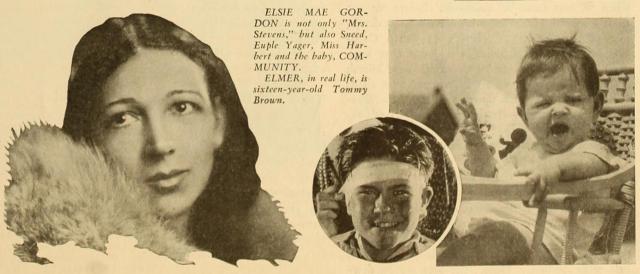
Elsie Mae (May) Gordon had a number of roles on Real Folks including Bessie Stevens, the village dressmaker and gossip, Flora May Harbart, the school teacher, Delia, Mrs. Jones’ Irish maid, Elmer’s friend “Sneed” Yeager, and even a baby named Community. During this same period Gordon was also playing Maybelle, the weepy heroine of WABC’s Hank Simmons’ Showboat. Gordon had trained at Emerson College of Oratory (now just Emerson College) in Boston and while an undergraduate performed at Boston’s Little Theatre. After college Gordon spent seven years performing the Chautauqua circuits that were popular during the era before returning to the East Coast and scratching out a living in Broadway and vaudeville shows before entering radio. Gordon stayed active in radio for many years after, at least to the mid-1940s.

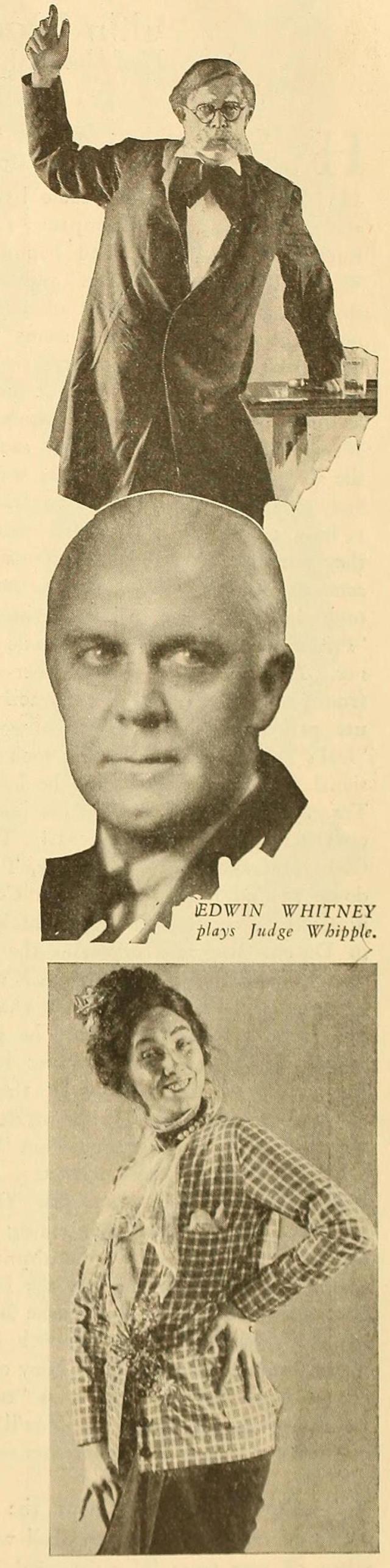
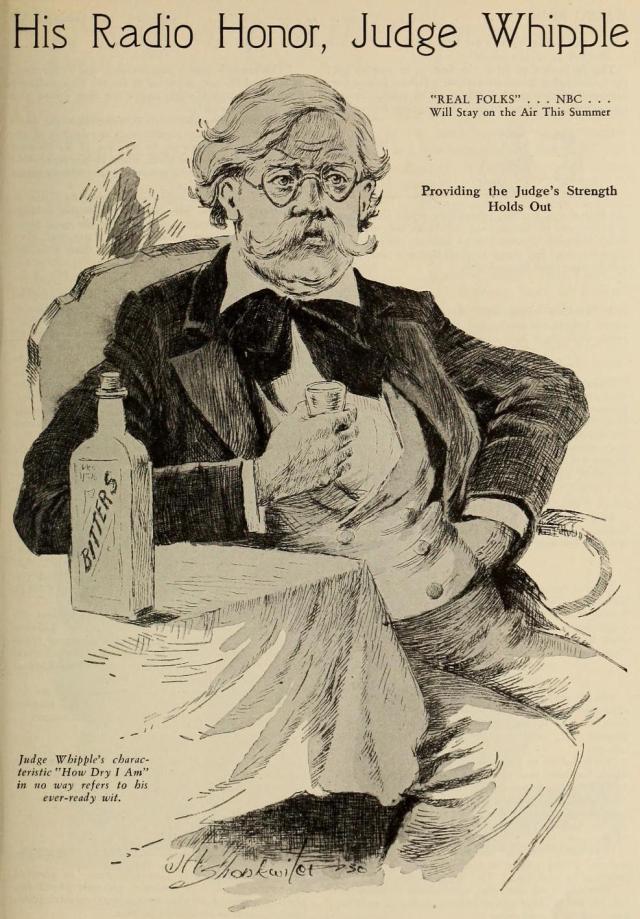
Edwin Whitney was yet another cast member with a notable theater background who was very busy in New York radio at the turn of the decade. Originally from Parma City, NY, Whitney sang with the Whitney Brothers Quartet (also Alvin, William, and Yale Whitney) and he even recorded a number of songs for Victor between 1908 and 1910. His bestseller was the now-cringeworthy “Darky and the Boys.” On Real Folks Whitney played the nap-prone Judge Whipple, Gran’pa Overbrooks, Bill Perkins the station agent, Colonel Weatherbee, and a dog named Prince. Elsewhere on the dial he played Cap’n Jimmy Norton on Harbor Lights, various roles on Death Valley Days, and appeared on The Esso Hour.

G. Underhill Macy, who had two main roles as Mrs. Jones’ gardener Tony the Wop, and later Fred Tibbets, Thompson Corners’ local barber who hoped to win the hand of Flora Mae Harbert. Both of these roles originally were held by Phil Cook. A theatre and vaudeville veteran, Macy also played the lead role in WABC’s Hank Simmons’ Showboat for a time before being replaced by that show’s producer, Harry Browne.

George Frame Brown and His Real Folks, Pt. 4

This article originally appeared in Radiogram, January 2016.

Main Street Sketches

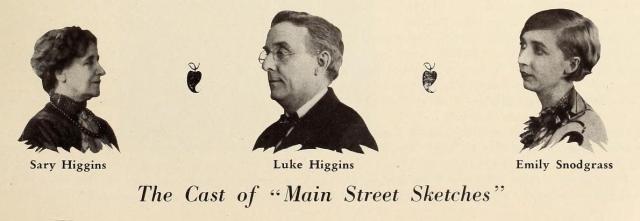
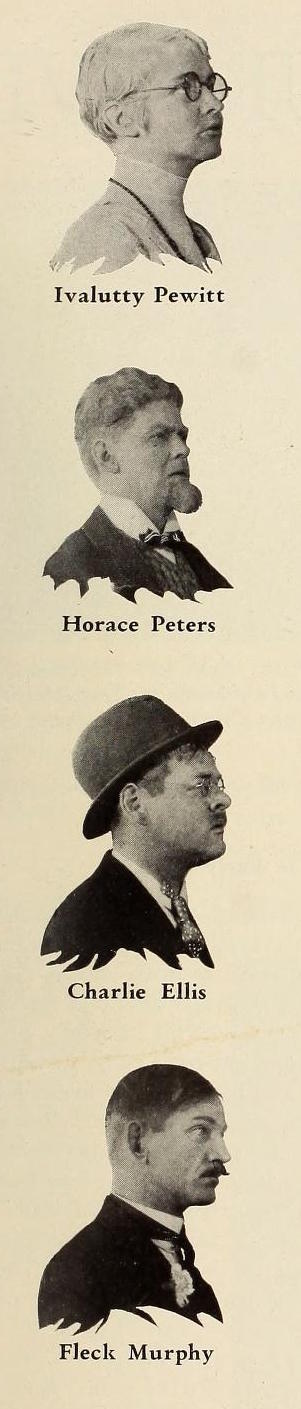
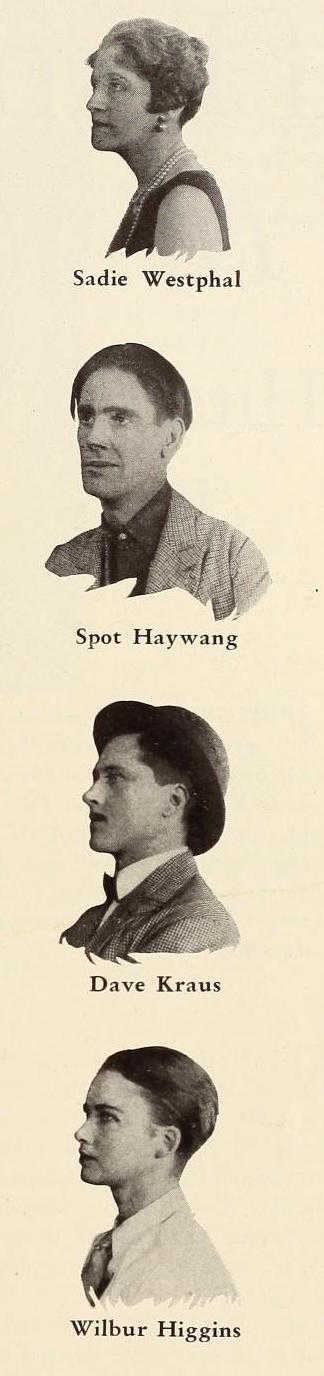
Main Street Sketches upon its January 1928 debut was immediately popular. In the imaginary town of Titusville Brown, Brown – a monologist and master of voices from his theatre days – led the cast and played many of the parts himself. Most notable among them was the role of Luke Higgins, a “lovable soul of the great open spaces” and mayor of Titusville. Virginia Farmer was cast as Sarah (Sary) Higgins, Luke’s wife. The music was provided by the Titusville Hook and Ladder Band and sometimes the Green River Hose Company Concert Cornetists. Roger Bowers was producer and director of Main Street Sketches as well as portraying Fleck Murphy. He had entered radio in 1927 as an announcer for WMCA before moving to WOR in 1928. A number of other characters have been identified from the series but the actors who played them are still unknown. The characters included Ivalutty Pewitt, Sadie Westphal, Horace Peters, Spot Haywang, Charlie Ellis, Dave Kraus, Wilbur Higgins, and Emily Snodgrass.

A sample episode focused on a benefit given by the citizens of Titusville on behalf of the Widow Clemmens whose house was lost in a fire. The Titusville Ladies’ Literary, Shakespearian and Browning Society provided some of the benefit’s entertainment as did the Hook and Ladder Company Band with Luke Higgins acting as master of ceremonies.

For the first couple months it was on the air WOR could not find a sponsor for Main Street Sketches. Then, when station salesmen inadvertently promised the program to two different sponsors WOR took it off the air briefly so neither company would benefit from its broadcast. Both commercial interests backed out of the deal upon discovering the confusion. The show was drawing listeners, however, and Reid Ice Cream stepped up to sponsor it. It was in the midst of this confusion that Brown was offered the opportunity to take his characters to cartoon strips, motion pictures, and the theatre. Thus, he departed WOR seeking to use his voice talents and characters in bigger opportunities under the assumption the station would cancel the series. Executives at WOR had other ideas and continued Main Street Sketches with replacement cast members. Brown was livid and sought relief in court.

In a situation reminiscent of Freeman Gosden’s and Charles Correll’s attempt at nearly the same time to take their Sam ‘n’ Henry creation to a competing station, Brown claimed that his characters, including Luke Higgins, were his creation and thus his property, not the property of the station. Lawsuit filed, Brown left WOR along with Virgina Farmer, a fellow Main Street Sketches actress who would follow Brown to his next radio production. Fallout from the rift also resulted in Gannon and WOR sales executive R. D. Newton leaving the station and George Coats of the Arthur Judson Radio Program Corp. that placed material on WOR leaving his position as well. The latter three were accused of trying to sell Main Street Sketches to rival networks and summarily excused from their responsibilities.

Ultimately New York Judge Valentine ruled in favor or WOR’s owner, the department store L. Bamberger & Co., “as to the imitation by defendant’s [WOR’s] employees of his mimicry and of the principal character he represents, this is no more the subject of exclusive appropriation than the method of portrayal of a role in a new opera by an artist who ‘created’ it, in the sense of being the first to portray it.” Thus stations were given first rights to material broadcast over their facilities and were fully entitled to use any performers they chose in those broadcasts.

Recordings from these primitive days of network radio are extremely rare but there is a recording of Main Street Sketches that survives on a Diamond Disk (EXP-159-B) and is available for listening online (https://wfmu.org/playlists/shows/9526). It runs about 15 minutes and was recorded on an experimental long-play record format from May 15, 1928.

George Frame Brown and His Real Folks, Pt. 3

This article originally appeared in Radiogram, January 2016.

Leonard E. L. Cox

Leonard E. L. Cox is no less fascinating a character, with nomadic tendencies that few could match. He was born in Chandi, British Central Africa (present-day Malawi) to a father who was a Chief Commissioner. At the age of eight he was sent from his home in Africa to London to live with relatives for a brief time. Within a short time his parents retrieved Cox and the family toured Europe until the outbreak of the second Boer War I in 1899 whereupon his father had to return to Britain’s service.

After a year of service there the Cox family once again packed their bags and set off for Canada where they settled about 90 miles from Calgary and started ranching. The endeavor didn’t pay off and the family headed due south, settling into a water station on the Southern Pacific Railroad somewhere between Tehachapi and Bakersfield, CA, where his father worked filling locomotives with water as they passed by.

Upon moving to Mojave Cox, now a young man, went to work in the area’s gold mines and finally learned to read and write English, supplanting his native French. A year in the mines was enough and Cox finally set off from his family and made his way to Los Angeles by 1902. He got back into ranching working for a Basque landowner who continued teaching him English and from there Cox went to work in a L.A. bookstore and he continued his English studies at night school.

Cox’s English improved enough that he was able to land a job with the Los Angeles Times as the editor of the yachting section. This position lasted for several years until the 1910 bombing of the Times building by the McNamara brothers. Once again Cox began to wander, taking a number of jobs in the Northwest lumber camps, Alaskan fish packing warehouses, and Southwestern farms and ranches.

Within a year or two Cox got his first taste of radio as it existed in the early 1900s. While working as an office boy for the Commercial Pacific Cable Company he studied telegraphy, the wireless transmission of messages by Morse code, and subsequently earned his operator’s license and was placed in charge of some small stations in the South Pacific. Still, Cox’s job carousel was not complete.

San Francisco was Cox’s next stop, whereupon he worked as a crane operator in a ship plant and then as a waiter and hotel clerk in Los Angeles. He experimented with another emerging technology, airplane flight, after getting to known aviator Ralph Newcomb.  The pair flew a Curtiss plane cross-country from Los Angeles to Florida’s Daytona Beach. After a fruitless job search in New York, Cox returned to California where he got work as an extra with the Kalem Motion Picture Company, Vitagraph, 101 Bison, Fox, Essanay and Triangle movie companies.

World War I broke out and in 1914 Cox enlisted with the Canadian Engineers and was shipped overseas to France. Transferred then to the Royal Flying Corps, he was wounded at Liege and sent to Greenwich, England for recovery. After returning to the States Cox was reinjured working in a shipbuilding yard when a bilge fell on him. Bad luck followed him to Arizona where, after two days in a copper mine, Cox was buried for 72 hours in a cave-in nearly 1,500 feet underground. Out of the hospital for the third time, Cox decided on safer work and became a travelling salesman of car accessories and appliances.

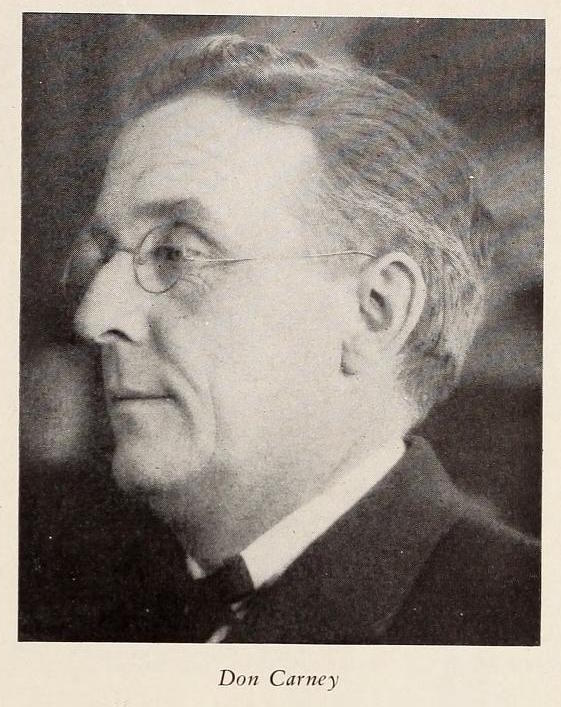
Tiring of that work, Cox ended up back on the East Coast selling radio sets in Boston and editing the radio section of the St. Augustine News in sunny Florida. His interest in radio was truly sparked now and he spent the mid-1920s traveling the riverways operating a radio shop from his motor boat. This segued into radio work at New York’s WJZ as a part-time announcer and producer. Cox switched to rival WABC after one year and began creating various programs, some reformatting the vaudeville sketches of earlier decades. One such program was Nights at Tony Pastor’s. Finally in December 1927, after the successful Thanksgiving broadcast Cox officially took a position with WOR where, as program director, he was responsible for a number of series in addition to Main Street Sketches.