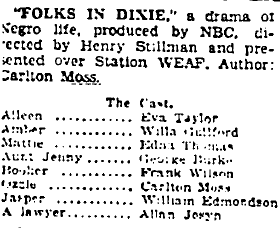
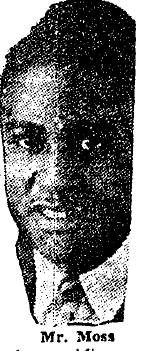
Folks From Dixie Broadcast Log

This is an initial broadcast log of Carlton Moss’ Folks From Dixie based on newspaper schedules. It may be the most accurate log we can compile until NBC documentation is unearthed providing all the official broadcast dates and times.

Folks From Dixie

Sunday 1:30 – 2:00 WEAF

5/7/33

5/14/33

5/21/33

5/28/33

6/4/33

6/11/33

6/18/33

6/25/33

7/2/33

7/9/33

7/16/33

7/23/33

7/30/33

8/6/33

The Radio Career of Carlton Moss, pt. 4

The Chicago Defender was perhaps unduly ebullient in praising Careless Love, claiming the show was “becoming as popular in Harlem as Amos ‘n’ Andy.” The Baltimore Afro-American also referenced Careless Love in relation to Amos ‘n’ Andy, declaring that NBC deserved recognition for putting the program on the air when so much radio content “simply burlesque[d]” blacks. Unfortunately for Moss, Careless Love was apparently not as popular nationwide as in Harlem. It was frequently moved around the broadcast schedule, playing on different days of the week at various times. Broadcast logs even indicate the program’s length varied between fifteen and thirty minutes. Further, as of May 29, 1931 the series was switched from WEAF to WJZ (also out of New York), which was a part of NBC’s Blue network. While any African-American project of this sort would have struggled to find a comfortable audience in that era, the constant broadcast shuffling could only have damaged efforts to solidify that audience.

To the program’s credit, when NBC Blue attempted to cancel Careless Love in March 1932, audience reaction was such that broadcasts were resumed for another two months. Ultimately, its following was not enough to save the program and Careless Love left the air on May 15, 1932, one-and-a-half years after it debuted.

An eighteen-month network run for a writer new to radio – even in this early era – should be considered a success. Just as admirable as the length of its broadcast run was the geographical diversity of stations airing Careless Love. Via its slot on the NBC schedule, the series reached listeners coast-to-coast, from Seattle to San Francisco and from Houston to Boston. In addition to these large urban centers with more significant African-American populations, the series was picked up in much smaller and whiter markets such as Council Bluffs, IA, Portland, ME, and Covington, KY.

Aiding Moss in presenting these stories of African-American life every week was a company of all-black actors and actresses, many of whom had notable theater credentials. Among them were Georgia Burke, Edna Thomas, singer Eva Taylor, Frank Wilson (who featured in the original stage run of “Porgy and Bess”), Wayland Rudd, Richey Huey, Ernest Whitman, Inez Clough, Georgette Harvey, and Clarence Williams. Several of these same performers would later be cast in Moss’ subsequent radio efforts. The Southernaires, a black gospel quartet formed in New York City in December 1930, would eventually provide incidental music for Careless Love. The Southernaires were an all-black quartet comprised of William Edmonds, Jay Toney, Lowell Peters, and Homer Smith, who provided music for much of Moss’ other radio work as well. Of this group only the Southernaires could truly be considered to have become radio stars in any sense of the term, remaining on radio for two decades with their own Sunday morning show.

Moss’ sophomore effort for NBC was entitled Folks From Dixie and it debuted May 7, 1933, again on WEAF. The show replaced Moonshine and Honeysuckle, a “dramatic series of the Kentucky mountains” which had run for nearly two years. At least one critic who was initially skeptical of the programming change said “it’ll have a tough job” replacing Moonshine and Honeysuckle. He later admitted after hearing the premier of Folks From Dixie that the show was “a worthy successor to the Moonshine and Honeysuckle skit.”

Roi Ottley of the New York Amsterdam News summarized the premise of the series on one of his columns, providing more insight to the story lines of this program than of any of Moss’ other works. Set in Abbeville, GA, then in Oklahoma, stories revolved around Aunt Jenny Jackson (Georgia Burke) who inherits $50,000 from a deceased relative. Episodes revolved around Aunt Jenny’s management of the fortune, balancing her wishes with the needs of her nephew, Ozzie (Moss), and Ozzie’s beau, Amber. The wealthy villain, Jasper, provided further anguish for Jenny. Of Moss’ radio efforts detailed here, Folks From Dixie appears to be a bit of an outlier with its more humorous content.

This series did not catch the public’s imagination. Folks From Dixie ran weekly beginning May 7, 1933, only until August 6, 1933, a mere fourteen weeks. An early Sunday afternoon time slot (1:30 – 2:00) likely did not help. Interestingly, despite a significantly shorter run, it appears that Folks From Dixie achieved wider network distribution than the longer running Careless Love. Records indicate it aired on at least 50 stations, four to five times as many as Careless Love at points in its run. Similarly, the stations were even more diverse, encompassing the continental U.S.; Seattle to San Diego, New Orleans to Miami, Detroit to Fargo, ND, and all points in between. Significantly, it aired outside the U.S. on at least two stations, CFCF in Montreal and CKGW in Toronto.

A rare interview concerning this series provides modern scholars with a glimpse of the politics with which Moss dealt during his radio career. In response to a letter-writer’s request that Moss create a serious series in the nature of the Jewish serial The Goldbergs, Moss indicated he was very interested in such a program. However, NBC at the time wanted a comedy series, thus he was compelled to give Folks from Dixie a comic theme. While Moss does not complain outright in the short response, it is clear that the show’s humorous tone was not his preference. Ottley was less than impressed with the results. Couldn’t he have been “persuaded to write something more adult?” Ottley wondered. Perhaps this lack of enthusiasm by the writer and lack of support by the critics led to the program’s short duration.

Careless Love Broadcast Log

This is an initial broadcast log of Carlton Moss’ Careless Love based on newspaper schedules. It may be the most accurate log we can compile until NBC documentation is unearthed providing all the official broadcast dates and times.

Careless Love

Saturday 8:30 – 9:00 WEAF

11/15/30

Saturday 8:00 – 8:30

11/22/30

11/29/30

12/06/30

12/13/30

12/20/30

Friday 9:30 – 10:00

12/26/30

1/2/31

Friday 9:45 – 10:00

1/9/31

1/16/31

1/23/31

1/30/31

Monday 7:30 – 8:00

2/2/31

2/9/31

2/16/31

2/23/31

Monday 7:30 – 7:45

3/2/31

3/9/31

3/23/31

4/13/31

Monday 7:45 – 8:00

4/20/31

4/27/31

Monday 7:30 – 8:00

5/4/31

Friday 9:30 – 9:45

5/15/31

Friday 8:45 – 9:00 WJZ

5/29/31

Friday 8:30 – 8:45

7/10/31

7/17/31

Friday 11:30 – 12:00

7/24/31

7/31/31

Saturday 9:00 – 9:30

8/29/31

9/5/31

Saturday 9:15 – 9:30

9/12/31

9/19/31

9/26/31

10/03/31

Saturday 9:00 – 9:30

10/10/31

10/24/31

10/31/31

Sunday 2:15 – 2:30

11/8/31

11/15/31

11/22/31

11/29/31

12/6/31

12/13/31

12/20/31

12/27/31

1/3/32

1/10/32

1/17/32

1/24/32

1/31/32

2/21/32

Sunday 12:30 – 12:45

2/28/32

3/13/32

3/20/32

3/27/32

4/3/332

4/10/32

4/17/32

Sunday 12:00 – 12:30

4/24/32

5/1/32

Sunday 12:15 – 12:30

5/8/32

Sunday 12:00 – 12:30

5/15/32

The Radio Career of Carlton Moss, pt. 3

How Moss came to be granted a radio writing assignment is unknown; in fact, all behind-the-scenes information about this radio series is a mystery. Possibly he received the opportunity at such a prominent station so it could direct some programming at the city’s sizable African-American population. Perhaps he’d made connections at the larger station while working at WEVD. Whatever the reason, the weekly Careless Love premiered at 8:00 p.m. on Saturday, November 15, 1930, over WEAF. In doing so the series must be seen as the first African-American dramatic material written for radio. Despite being overlooked by all other accounts of black radio history, Careless Love should also be considered the first non-musical African-American feature (though it featured musical interludes) and the first such black feature to be aired over a network.

Accounts of Careless Love’s content are rare and brief, giving radio historians only the vaguest sense of its content. The show’s announcer opened each episode with the following: “[They are] stories of Negro life in the South – stories of yesterday and today – simple stories that throb with heart-beat and emotion – the character and feeling of Negro people, written by a Negro pen.”

The earliest account of the series comes from the New York Amsterdam News, just a few weeks after its debut. While the paper did not, apparently, regularly comment on radio features, it felt the need to mention Careless Love due to its “high quality of the acting and singing.” In 1931, after nearly a year of being on the air, the Chicago Defender described it thus, quoting the aforementioned opening and also giving a brief storyline:

“These are stories of Race life in the South, stories of yesterday and today, simple stories that throb with heart-beat and emotion – the character and feeling of the Colored people – written by a young Race boy, Carlton Moss.

Saturday night’s sketch was called “Big Eddy’s Partner.” The history of a young Colored boy who came from an upcountry farm to the docks of New Orleans.”

The only Careless Love installment for which any expanded story synopsis has been discovered was called “Susie’s Solitaire” and was described in depth in the Pittsburgh Courier:

“The Careless Love group which entertains each Sunday over the national network presented a very interesting sketch as part of a series of colored folk stories called “Susie’s Solitaire.” Bringing to the air a little sentimental domestic scene illustrating Negro characteristics. It is well done and those who are devotees of Negro folk tales should make it a point to hook in on future broadcasts, for they will enjoy those stories.

In this one a colored girl, Susie Jackson, has returned to her home in a little town from Nashville, where she works in a hotel. It is Sunday morning and she must go to church with Simon her former sweetheart. But Susie wants them to know that she wishes no further part of Simon because she’s now “the sharpest girl in Nashville” and has won the $200 diamond ring affection of “Jelly Roll” Williams, “not a gambler but a professional sporting man.” And why should she bother about Simon? Tut, tut and tish. She engaged to Simon? No such thing. She’s the “hot baby” of “Mr. Jelly Roll Williams.” So, they go to church without her.

Then comes “Mr. Jelly Roll Williams,” all dust-covered and worried looking. He gave her that ring? Crazy gal: Ha, ha! What a laugh, give him that ring. He smacks her and gets it and she winds up in the arms of Simon with no more Nashville for her.

The little sketch was played with great realism and earnestness and anybody listening to it could easily imagine they were hooked in on the real thing. Good dialogue was delivered with genuine Negro feeling and emphasis.”

Since scripts have yet to be uncovered, the only information now available concerning the content of Moss’ radio work is write-ups in the black press. Folk-lore and legends were popular sources of stories, including “Stack-o-Lee,” “John Henry,” “Hard Trials,” “Corn Cob Roll,” “The Ghost Wrestlers,” “The Fall of the Conjure,” “The Ways of Satin,” and “Aaron’s Conjure Scare.” What the Baltimore Afro-American dubbed “Good … plays of character” included “Big Eddy’s Partner,” “Easter Parade,” and “A Son of the Soil.” Comedic entries included “Callie’s Santa Clause,” “A Good Woman,” and “Luke’s Courtship.” Other stories included “Hard Trials” and “Tinsel Preferred” for which the Baltimore Afro-American provided a short summary: “[The episode] is a sympathetic story of a girl who quit a road show to return to her laboring husband. When she finds that her husband has had his leg amputated, she goes back to the bright lights.”

The Radio Career of Carlton Moss, pt. 2

Perhaps the first black-centric radio series that didn’t consist entirely of music was the Pittsburgh Courier Radio Hour heard over WGBS, New York, beginning in November 1927. Hosted by the Courier’s New York writer Floyd Calvin, it was an hour of musical performances surrounding a ten-minute talk on a topic of African-American interest. The Courier Hour began as a monthly broadcast and eventually received a weekly slot after moving to another New York station, WCGU, in early 1928 where it was renamed the Floyd Calvin Program (or Hour). Two months after the unveiling of the Courier’s hour, The Negro Achievement Hour broadcast debuted over WABC (also New York City) on January 26, 1928. It too was a mix of music and presentations on matters of interest to African-American listeners. Sponsored by various African-American businesses, topics included the history of black newspapers, the growth of Harlem, and black members of the Elks Fraternal Organization. A year later in 1929 The All Negro Hour, perhaps the most frequently cited example of early African-American radio, went on the air over WSBC in Chicago. The series was produced and hosted by Jack Cooper. Accounts describe it as a variety show with skits, interviews and plenty of musical numbers. This effort has earned Cooper recognition as the first African-American to make a career in radio; indeed, he was on the air for decades to come. The program did feature what may have been the first ongoing sketch performed by black actors, Luke and Timber. Basically a song-and-patter show, contemporary reviews indicate there was some degree of continuing storyline from performance to performance. Notably, none of these shows are known to have received network distribution.

In addition to The Floyd Calvin Hour, The Negro Achievement Hour, and The All Negro Hour, there were occasional one-shot broadcasts that were more than musical concerts. These included Ridgely Torrence’s play Rider of Dreams presented over WOR by the New Art Theatre, Harlem, and stage shows like the first successful all-black musical “Shuffle Along”. Still, these pioneering African-American series and one-shot broadcasts rarely offered dramatic fare that reflected a serious introspection of black life in America. The few dramas that were broadcast, such as Rider of Dreams, were not original creations for radio. The closest such feature was Amos ‘n’ Andy, the story of Harlem African-Americans as written and played by two white men. Amos ‘n’ Andy was a daily (except Sundays) program that debuted March 19, 1928, after a two-year run as Sam ‘n’ Henry. The merits of the program, which was alternately a comedy and drama, have been debated practically since its aural inauguration, and need not be reviewed here.

When a young black actor named Carlton Moss arrived in New York City sometime in the summer or early fall of 1929, there was little indication that he would become the first African-American dramatic writer for radio. The first record contemporary scholars have of Moss’ artistic inclinations are reviews of his theater work while a student at Morgan College (now Morgan State University) in Baltimore. There he found notable success in theater productions during the late ’20s. The Baltimore Afro-American gave some ink to Morgan College’s dramatic productions, several of which featured producer-turned-actor Moss. Under the leadership of Randolph Edmunds, Moss played in the College’s productions of “The Goose Hangs High” and “Nothing But Truth,” both during the spring of 1928. By his last year of school Moss was the drama club’s vice-president and starred as the title character in “Aaron Boggs, Freshman” (fall 1928). During the spring of 1929 the Morgan troupe played in New York, performing three plays as a fundraiser: “The Man Who Died at 12 o’clock”, “The House of Shame,” and “Shirlock Bones.”

Sometime between finishing at Morgan College after the spring semester and October 1929, Moss returned to New York (having been raised in nearby Newark, New Jersey) where he got a job working with the Alhambra stock company. For the time being he continued to be referred to as “Ritz” Carlton Moss (presumably after the hotel), a moniker he’d acquired in college. Though details of these early days in New York have yet to be uncovered, within a year of his arrival the aspiring dramatist had worked his way into a radio gig. By May 1930, Moss was appearing on WEVD’s Intercollegiate Dramatics, a Sunday afternoon program. Unfortunately, radio listings from the era generally don’t include smaller stations like WEVD so it is virtually impossible to reconstruct a broadcast record for the show that would make clearer how long it ran and what its content may have been. This appears to be Moss’ first work in radio.

After toiling away in theater for a year upon arriving in New York and working the aforementioned stint on WEVD, Carlton Moss was hired by WEAF (NBC Red network’s New York City affiliate) to write, produce, and act on a weekly series entitled Careless Love, an all-black dramatic radio production. One of the very few contemporary accounts of the series during its earliest days claimed “the themes for the sketches were suggested by W. C. Handy’s ‘blues’ and Negro plantation life.” The title surely reflected the classic blues tune of the same name, the melody of which was used by Handy in his song “Loveless Love.”

The Radio Career of Carlton Moss, pt. 1

Carlton Moss:

Radio’s First Black Dramatist

Originally published in the Old Radio Times, September/October, 2009.


The 1920s witnessed explosive growth in the American commercial radio industry. Within the decade the technology grew from the crude homemade apparatus of a small niche hobby group of amateur radio operators to a full-fledged industry that rivaled motion pictures for the American entertainment dollar. Stations proliferated across the country and fortunes were made many times over. NBC and CBS emerged as national networks bringing high quality performers into the living rooms of America. Radio’s first true hit, Amos ‘n’ Andy, debuted in 1928 and inaugurated a 30-year span in which comedy, drama, mystery, romance, and adventure programming would grace the airwaves before succumbing to the narrow diet of call-in talk shows, music, sports and news constitutes contemporary broadcasting in the United States.

Unfortunately, when African-American contributions to the first decade of the first true electronic mass medium are recounted, they are stunningly few, at least according to the radio history literature. These few recognized contributions were primarily musical broadcasts by popular African-American singers and jazz bands such as Ethyl Waters and Duke Ellington. There is no evidence so far to point to an African-American radio series that was not primarily musical in nature during the 1920s. Nevertheless, even this limited success with musical programs during the ’20s was more than black performers would experience on the air for two decades to come. Radio historians J. Fred MacDonald and William Barlow attribute the closing of this brief window of success to the increasing dominance of two networks by decade’s end, the Depression’s toll on black entertainment ventures, and the power of white musicians unions. These three factors would virtually shut African-Americans out of the radio industry during the ‘30s, ‘40s, and ‘50s.

Before the rise of networks in the late 1920s, radio was fragmented, with stations focusing primarily on local audiences. This allowed increased opportunities for black performers because more local programming was aimed at black audiences, especially in urban markets. As more stations joined the major networks, NBC (owner of two networks, the so-called Red network and Blue network) and CBS, content had to be increasingly aimed at the largest possible audience to maximize benefit for the national sponsor, and that meant appealing as much as possible to middle class whites who made up the vast majority of the radio audience at the time.

From the late ’20s to mid-’30s NBC and CBS seized control of 97% of nighttime broadcasting. It was a whiteout: neither network was interested in hiring African-Americans in any capacity other than performer, and even those instances were rare. That none of the networks’ affiliates had black ownership only exacerbated the situation. Further detrimental to black programming was a low rate of radio-set ownership by African-Americans, about 14% in urban areas compared to 56% of whites in similar areas.

Advertisers naturally wanted to stay clear of scandal at any cost lest it cost them sales. Therefore, they actively avoided sponsoring any content that might raise the spectre of race. To avoid offending the Southern audience advertisers minimized the black presence and ensured what presence there was was appropriately servile and inoffensive.

Larger macro-economic forces were working against African-American performers through the onset of the Great Depression, as well. A strong base of black talent developed during the teens and twenties through the black recording studios and Theatre Owners’ Booking Association (a black vaudeville circuit) supplied a strong professional class of black musicians and actors across the country. Both of these industries were devastated by the nation’s economic woes and virtually disappeared by the thirties, depleting the pipeline of first-rate talent available to radio.

A third roadblock to African-American participation in radio was their white co-workers. Since much of radio’s content during the 1920s was live music, this offered an ideal opening for black musicians. Indeed, some, including Bessie Smith, Duke Ellington, Ethel Waters, and Louis Armstrong, were prominent staples of the broadcast schedule. But beyond the headliners it was difficult for blacks to make inroads on the music programs. Many of the early radio bands were made up of members of the American Federation of Musicians that did not encourage African-American membership. Since union musicians booked most of the major hotels and theaters (from where many musical broadcasts originated), they increased their presence with radio as it grew and effectively blocked entrance to this area of radio to blacks.

The extent of local black-oriented programming aired during the 1920s may never be fully realized due to the paucity of surviving documentation from radio’s first decade. While most published accounts of African-Americans in radio begin with the handful of black actors and actresses in the 1930s and the disc jockeys and few black dramatic series of the 1940s, at least three black variety programs were on the air between 1927 and 1929. Though consisting mostly of music, there was additional content that differentiated them from the black jazz performances found across the radio spectrum.