George Frame Brown and His Real Folks, Pt. 3

This article originally appeared in Radiogram, January 2016.

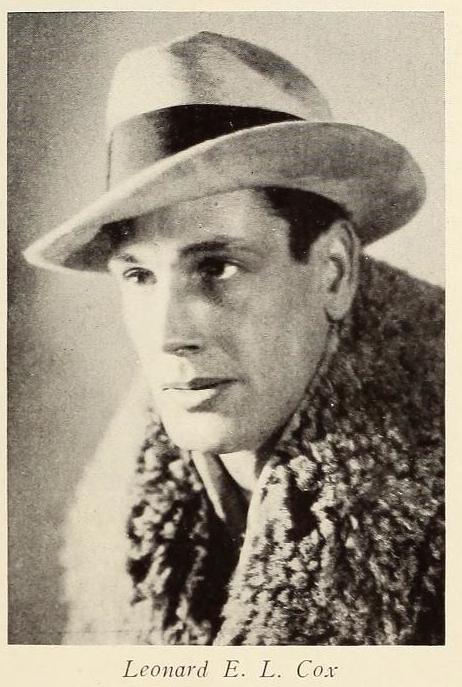
Leonard E. L. Cox

Leonard E. L. Cox is no less fascinating a character, with nomadic tendencies that few could match. He was born in Chandi, British Central Africa (present-day Malawi) to a father who was a Chief Commissioner. At the age of eight he was sent from his home in Africa to London to live with relatives for a brief time. Within a short time his parents retrieved Cox and the family toured Europe until the outbreak of the second Boer War I in 1899 whereupon his father had to return to Britain’s service.

After a year of service there the Cox family once again packed their bags and set off for Canada where they settled about 90 miles from Calgary and started ranching. The endeavor didn’t pay off and the family headed due south, settling into a water station on the Southern Pacific Railroad somewhere between Tehachapi and Bakersfield, CA, where his father worked filling locomotives with water as they passed by.

Upon moving to Mojave Cox, now a young man, went to work in the area’s gold mines and finally learned to read and write English, supplanting his native French. A year in the mines was enough and Cox finally set off from his family and made his way to Los Angeles by 1902. He got back into ranching working for a Basque landowner who continued teaching him English and from there Cox went to work in a L.A. bookstore and he continued his English studies at night school.

Cox’s English improved enough that he was able to land a job with the Los Angeles Times as the editor of the yachting section. This position lasted for several years until the 1910 bombing of the Times building by the McNamara brothers. Once again Cox began to wander, taking a number of jobs in the Northwest lumber camps, Alaskan fish packing warehouses, and Southwestern farms and ranches.

Within a year or two Cox got his first taste of radio as it existed in the early 1900s. While working as an office boy for the Commercial Pacific Cable Company he studied telegraphy, the wireless transmission of messages by Morse code, and subsequently earned his operator’s license and was placed in charge of some small stations in the South Pacific. Still, Cox’s job carousel was not complete.

San Francisco was Cox’s next stop, whereupon he worked as a crane operator in a ship plant and then as a waiter and hotel clerk in Los Angeles. He experimented with another emerging technology, airplane flight, after getting to known aviator Ralph Newcomb.  The pair flew a Curtiss plane cross-country from Los Angeles to Florida’s Daytona Beach. After a fruitless job search in New York, Cox returned to California where he got work as an extra with the Kalem Motion Picture Company, Vitagraph, 101 Bison, Fox, Essanay and Triangle movie companies.

World War I broke out and in 1914 Cox enlisted with the Canadian Engineers and was shipped overseas to France. Transferred then to the Royal Flying Corps, he was wounded at Liege and sent to Greenwich, England for recovery. After returning to the States Cox was reinjured working in a shipbuilding yard when a bilge fell on him. Bad luck followed him to Arizona where, after two days in a copper mine, Cox was buried for 72 hours in a cave-in nearly 1,500 feet underground. Out of the hospital for the third time, Cox decided on safer work and became a travelling salesman of car accessories and appliances.

Tiring of that work, Cox ended up back on the East Coast selling radio sets in Boston and editing the radio section of the St. Augustine News in sunny Florida. His interest in radio was truly sparked now and he spent the mid-1920s traveling the riverways operating a radio shop from his motor boat. This segued into radio work at New York’s WJZ as a part-time announcer and producer. Cox switched to rival WABC after one year and began creating various programs, some reformatting the vaudeville sketches of earlier decades. One such program was Nights at Tony Pastor’s. Finally in December 1927, after the successful Thanksgiving broadcast Cox officially took a position with WOR where, as program director, he was responsible for a number of series in addition to Main Street Sketches.
George Frame Brown and His Real Folks, Pt. 2

This article originally appeared in Radiogram, January 2016.

George Frame (Francis) Brown

On March 1, 1896, Brown was born near Seattle, WA, a continent away from the rural New England hamlets that would serve as backdrops his future radio shows. His parents were pioneers in the region and his father ran a small store and supply company. As a young man Brown planned a career in architecture but got sidetracked when the United States entered World War I. He shipped out overseas and saw action in France with the American Expeditionary Forces. During his time in the service he suffered from gas attacks that caused injuries from which he would periodically suffer for years to come. After returning from Europe Brown enrolled at the University of Washington where he modified his original plans and studied theatrical architecture and stage settings.

Exposure to the stage changed Brown’s mind yet again and he started to act in small parts in local productions. After writing a one-act play that ended up getting produced, Brown decided to try and make a full-time living in the theatre. Some time spent in Washington’s stock theatre scene convinced Brown to move to New York City and the lights of Broadway. He quickly found, however, that the lights can dazzle the eyes but they don’t fill the stomach. By his own account Brown was practically starving and had to perform what janitorial work he could find just to survive.

Even when a bit of luck fell his way something was sure to blow it. At one point Brown was offered a part for a tidy $100 per week, big money for a man with barely two nickels to his name. But at the worst possible time he experienced a lung hemorrhage and had to back out of the role, just one example of the gassing Brown experienced in France returning to haunt him.

Brown’s first appearance on radio was not planned and even a bit ironic. He earned a part in a stage production, “The Manhatters,” in the fall of 1927 that also featured future radio stars Raymond Knight and William Johnstone. The play made light fun of the then-new phenomenon of radio, but portions of the production were then actually broadcast over the air.

Intrigued by the idea of radio, Brown broadcast an early morning radio monolog that he later described as a “travesty.” He delivered cooking lessons and led exercises on the broadcast dubbed Cretonna in the Home. WRNY’s station manager liked it enough to invite Brown to do some monologs over his station. Brown agreed and subsequently did some broadcasts over WABC including a program called The Music and Musings of Dr. Mu in which he talked about a variety of topics in the guise of an old Chinese philosopher.


George Frame Brown and His Real Folks, Pt. 1

This article originally appeared in Radiogram, January 2016.

George Frame Brown knew he had a radio hit on his hands in 1928 with Main Street Sketches and there were several profitable avenues he could potentially follow. But first he had to get his creation away from WOR, and that station’s executives also recognized a moneymaker and had no intention of letting Brown walk out the door with the show. To understand how Brown’s Real Folks made it to the air, it’s necessary to understand events stretching back to the year before when its predecessor, Main Street Sketches, was first conceptualized.

A few days before Thanksgiving, 1927, New York’s WOR was in a bind. A special broadcast that staff had been planning fell through and they were now looking at a hole in their schedule on the big holiday. Station head Charles Gannon scheduled a meeting with his program director, Leonard E. L. Cox to discuss their options. On his way to the meeting Cox stopped to see his good friend George Frame Brown. Cox, on a whim and remembering Brown’s extensive performing background, invited Brown along to discuss the Thanksgiving broadcast with Gannon.

After throwing out different ideas the three men coalesced around a sketch built around an all-American Main Street and the assorted characters inevitably found in these small town shops and cafes. Cox went straight home and typed out a script based on the day’s conversations, using a general store for the setting. Brown, a gifted voice artist, supplied most of the voices for the program and after its Thanksgiving airing it received overwhelmingly positive letters from listeners.

Encouraged by the response, Gannon, Cox, and Brown began planning a follow-up broadcast for Christmas. That show, called “Christmas Eve in the Grange Hall,” evoked memories and images of the Grange, a post-Civil War rural organization focused on advocating for the small farmer in the face of growing corporate agricultural interests. Though of little direct relevance to urban listeners, the broadcast nevertheless found an enthusiastic audience and Gannon immediately assigned Cox the task of producing a weekly show based on the themes and characters proving so interesting to listeners.

Cox was not previously connected directly to production work with the station but Gannon gave him a weekly budget of $75 to bring the series to the airwaves. Most of that budget went to Brown, on whom Cox called to voice most of the characters initially. Cox himself did not receive extra pay for the new duties.

Fearful of a lawsuit by Sinclair Lewis, author of 1920’s Main Street, Cox’s sketch series was renamed Main Street Sketches at the last moment before going on the air for the first time Tuesday, January 3, 1928.

To understand the immediate appeal of Main Street Sketches it’s necessary to explore the unique talents brought to the effort by George Frame Brown and Leonard E. L. Cox.

Destination: Radio, A Look at Some of Chicago’s African-American Radio Pioneers, Pt. 2

Originally published in The Nostalgia Digest, Winter, 2013.

            The most famous of Chicago’s black radio performers is unquestionably Richard Durham who was born in Raymond, MS, on September 6, 1917 but spent most of his childhood in Chicago. One source claims he studied first at Wilberforce and Central YMCA College before attending Northwestern University in suburban Chicago where he participated in the first NBC-Northwestern University summer radio institute in 1942. Some of Durham’s earliest writing work came as a dramatist with the WPA’s Writers Project and as national editor for the black newspaper The Chicago Defender.

Durham’s first known radio work was a weekly series entitled Democracy – USA, aired on Chicago’s WBBM beginning May 4, 1946. It was a fifteen-minute series of Sunday morning broadcasts that dramatized the life of prominent African Americans. Sixteen months later in September, 1947 while Democracy – USA was still on the air, Durham’s second effort, Here Comes Tomorrow, premiered on WJJD. Considered the first black soap opera, this story followed the Redmond family and their son, Milton, who returned home with amnesia after fighting in Italy during World War II. Both Democracy – USA and Here Comes Tomorrow went off the air in the spring of 1948.

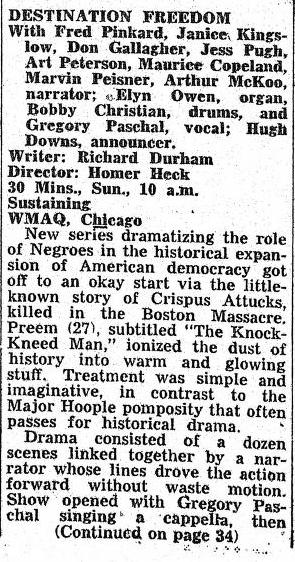
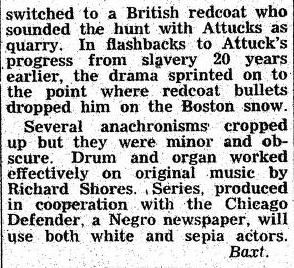
Destination Freedom, Richard Durham’s most enduring radio legacy, debuted June 27, 1948 over WMAQ. The basic premise of Destination Freedom, dramatizing the lives of individuals of African descent and prominent events in black history, was an extension of his original work Democracy – USA. Destination Freedom ran for two years, an impressive run for a program that never attracted a commercial sponsor, was not picked up by a network, and focused on the interests of African Americans. In 1956, six years after the program left the air, Durham filed suit against NBC for $250,000 claiming the network had continued to air episodes in the years since he had left despite his claims to all copyrights concerning the show.

The extent of Durham’s post-WMAQ writing is less clear. In a 1983 interview with John Dunning, Durham recalled leaving Destination Freedom to work on the Irna Phillips show What’s New? starring Don Ameci. According to Durham, the pay differential between the sustained Destination Freedom and a sponsored Phillips work was too much to pass up. He also commented in the same interview that frequently his name was not associated with scripts in order to avoid causing problems with Southern sponsors. One other known Durham script was the August 31, 1957, episode of CBS Radio Workshop which featured a story concerning Denmark Vesey, a slave who led an uprising in 1821. Vesey had been the subject of Destination Freedom on its July 18, 1948, broadcast. The extent of Durham’s radio writing may never be fully realized.

During the 1950s Durham worked for the Packinghouse Workers’ Union doing publicity and in 1958 served as the press agent for GOP Congressional candidate Dr. T. R. Howard. He followed these jobs with an editorship at Muhammad Speaks through most of the 1960s. In 1969, while he continued to work for Muhammad Speaks, Durham returned to writing for the electronic media. He was hired to script Bird of the Iron Feather (originally called More From My Life), an African American soap opera set in the Chicago ghetto that was broadcast over WTTW, Chicago’s public television station, beginning in January, 1970. Bill Quinn, assistant writer at Playboy, worked as an associate writer on the project. The effort lasted just seven weeks before going off the air due to a premature and unexplained disappearance of funds. In the late 1970s Durham worked with Mohammad Ali on the boxer’s autobiography which was released in 1977. Richard Durham passed away April 27, 1984, and was inducted into the National Radio Hall of Fame in August, 2007.

About the time that Richard Durham was hitting his stride with Destination Freedom, Vernon Jarrett and Oscar Brown, Jr., were teaming up on Negro Newsfront, a daily fifteen -minute radio news program broadcast over Chicago’s WJJD. Though historical records indicate the news show aired from 1948 to 1951, in a 1996 interview Brown recalled airing the newscasts from 1947 to 1952. Thus, it’s possible Jarrett was not involved with Negro Newsfront during its entire run on radio. A native of Tennessee, Jarrett made his career as a journalist in Chicago, first with The Chicago Defender beginning in 1946 then later with The Chicago Tribune and The Chicago Sun-Times. He provided news for Chicago-area television as well. Jarrett died May 24, 2004. The first known black news program in Chicago, Negro Newsfront was also one of the first African American radio newscasts in the country. Oscar Brown, Jr., claimed to have started the show in 1947 over WJJD, and subsequently took it to WVON then WHFC.

One final program of interest was created to promote local black talent. The Chicago Defender and station WBBM teamed up to sponsor Star Quest, a contest for amateur performers, a concept which transitioned easily to television and remains popular to this day. Star Quest (referred to as Star-Questers on at least one occasion) seems to have run just a few weeks from March to May of 1947 on Tuesdays and Thursdays. Finalists were chosen from each broadcast who then competed for the grand prize, a thirteen-week contract on WBBM which paid $100 a week. Over 450 men and women auditioned for Star Quest and some of the finalists included Harriet Clemons, Delores Baker, James Hampton, Gladys Beaman and Ira Burton but the grand prize winner is unknown.

By the late 1940s the black drama and variety programs of Cooper and Durham were waning and disc jockeys were taking their place. Some of Chicago’s first record spinners – beyond Jack Cooper himself – included Al Benson and Eddie Honesty both of whom had long radio careers.

Never representing more than a tiny fraction of the programming going out on Chicago’s airwaves, these pioneering African Americans, from Jack Cooper to Richard Durham to Oscar Brown, Jr., carved out a space where the city’s black citizens could listen to music, news, and serious drama created specifically about and for them.


The material in this article was adapted from entries in Ryan Ellett’s book Encyclopedia of Black Radio in the United States, 1921-1955, published by McFarland Press in 2011 and available on their website www.mcfarlandpub.com.

Destination: Radio, A Look at Some of Chicago’s African-American Radio Pioneers, Pt. 1

Originally published in The Nostalgia Digest, Winter, 2013

Few cities have a history as intertwined with early radio as Chicago. Such legendary stations as WMAQ, WLS, and WGN all date to the early 1920s and the city’s stations were second only to those of New York in producing original broadcast dramas during the 1930s. Less well known is the contribution that African Americans made to the city’s broadcasting scene as writers, producers, actors and newsmen. In addition to the countless musicians who filled Chicago’s airwaves with legendary jazz tunes nearly from the beginning of the era of commercial radio, the city could boast of a number of dramatic, variety, news, and talent programs through the 1930s and 1940s aimed at a black audience.

Black Chicagoans, in fact, were on the air even before commercial radio emerged after 1920, communicating with Morse code over the airwaves as professional and amateur operators. History may never reveal the very first Chicago-area African American wireless (as radio was referred to then) user, but Harry Daily must be among the earliest. Daily honed his radio skills while serving in the navy and then in 1914, after multiple rejections for government radio jobs due to his race, he applied successfully for a wireless job with the Red Star Line. Daily was subsequently denied the position when he showed up for work and the Atlantic liner discovered he was black, a fact which had not been clarified on the job application.

Another early operator who broadcast as an amateur and not a professional like Daily was 17-year-old Robert Crawford. While a student at Wendell Phillips High School in Chicago he built a fully functioning wireless station which included a homemade transmitter, receiver, and telegraph key. In 1916 he was identified as the only black member of the local Wireless Club.

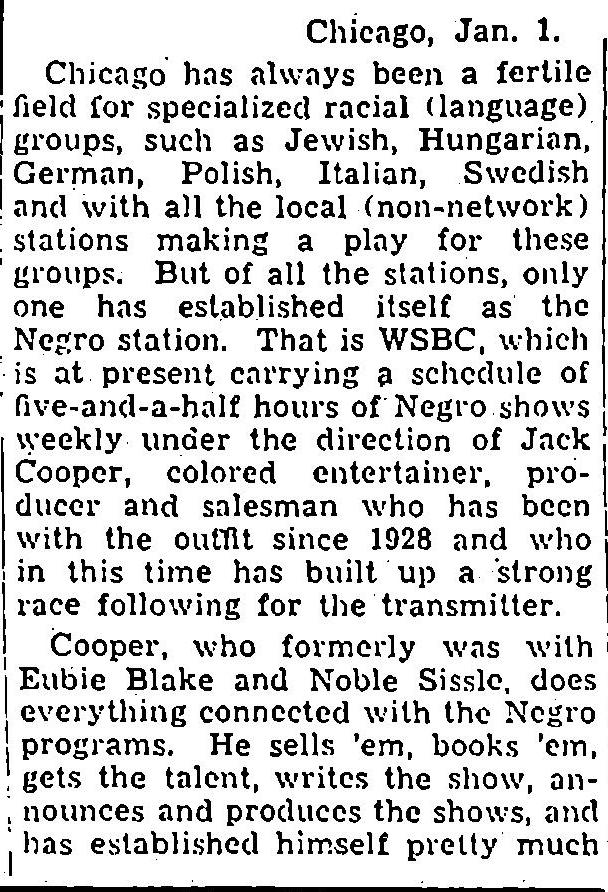
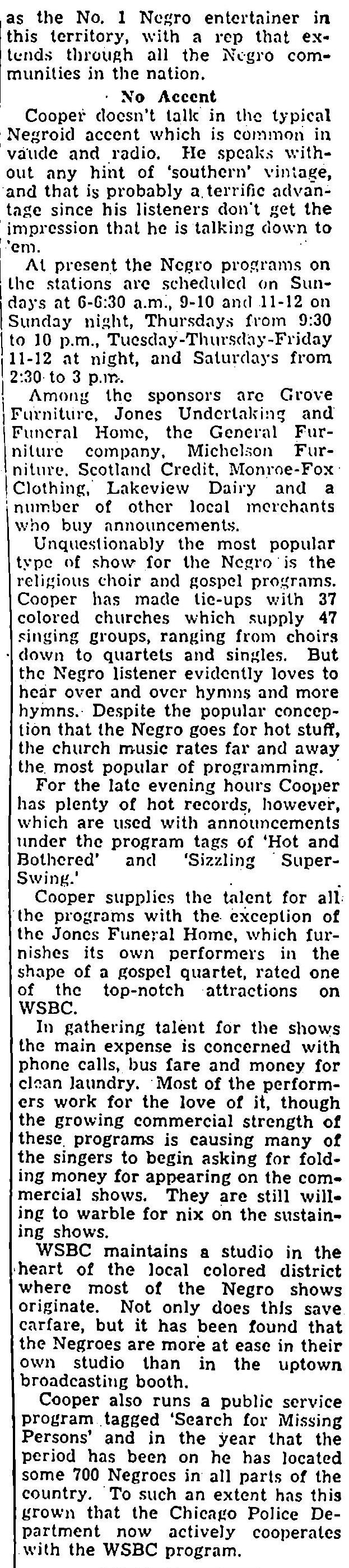
Chicago’s first black broadcaster of the post-1920 commercial era was Jack Cooper, widely regarded as the dean of African American radio professionals. Considered the first African American to make a career in the radio industry, Cooper spent most of his years on the airwaves creating and promoting radio content aimed at black listeners for their enjoyment and edification. After a short job with Washington, D.C.’s WCAE Cooper returned to Chicago where he debuted The All-Negro Hour over WGBS on November 3, 1929. Drawing on his years in vaudeville, Cooper created one of the first black-oriented entertainment programs for the medium. Audiences approved and the series ran weekly until 1935.

Building on the success of The All-Negro Hour, Cooper began creating additional shows by 1933. His formula was so successful that by 1935 Cooper was responsible for the content of 1/6th of WGBS’ broadcasting time. Nevertheless, Cooper biographer Mark Newman emphasizes that the would-be radio mogul struggled for years to get programmed on the station’s prime time hours. He was consistently relegated to late night and weekend slots. Among his numerous creations in addition to The All-Negro Hour during the early to mid-1930s were The Colored Children’s Hour, The Defender Newsreel, Midnite Accomodation, Timely Tunes, Midnite Ramble, and Nite in Harlem.

Cooper managed to produce so much programming by using prerecorded music instead of live performers, a gimmick he didn’t originate but one that he eventually used to his immense benefit. As early as 1931 he came to the realization that playing so-called race records (which were exempt from the ASCAP ban on playing such recordings) was considerably cheaper than paying live talent. The format was so successful that even his flagship show, The All-Negro Hour, cut most of its live singing, skits, and serials (only “Horseradish and Fertilizer” lived on).

Despite Jack Cooper’s apparent success as measured by airtime, financial security was elusive as long as he was blocked out of the best broadcasting times. In 1938, fourteen years after his first radio work and celebrating his 50th birthday, Cooper finally caught a break and had the opportunity to buy mid-afternoon time on WSBC and WHFC. He immediately programmed some new disc jockey shows called Rug Cutter’s Special, Gloom Chasers, and Jump, Jive, and Jam.

In June, 1947 he debuted Wardrobe Derby on WAAF sponsored by National Credit Clothiers. Participants competed for items of clothing including a complete wardrobe for the grand prize winner. He had two other shows at the time including Jivin’ With Jack, a daily record program. That year, according to Newman, represented the highpoint of Cooper’s radio enterprise whereupon he was weekly selling 40 hours of air time across four stations. Between 1946 and 1952 he produced Listen Chicago over WAAF, a public affairs program focused on topics of interest to black listeners. Other series created by Cooper over the years included Bible Time, Know Your Bible, Song of Zion, Songs By Request, Tomp Time, Evening Heat Wave, and Tips and Tunes with Trudy. Your Legal Rights offered legal advice to listeners. Another show, Missing Persons, claimed to have helped reunite thousands of black families separated during the migrations of the early 20th century. It took two decades but his tireless work paid off and in the final years of his career Cooper enjoyed a new level of financial prosperity, pulling in a reported $200,000 per year.

Though not known to have appeared on any of Jack Cooper’s programs, James Mitchell is recognized as one of the very few black child actors during this era. While a student at Chicago’s Dunbar Junior High School he used his radio paycheck to support his family during the mid-1930s. Mitchell made his broadcast debut on Uncle Quin’s Day Dreamers in January, 1933, as the character Wishbone. A group of children (all white except Mitchell) would make a wish on Wishbone’s magic wishbone and were then whisked anywhere they wanted to go. The program was aimed at children and featured historical stories while being aired from Chicago’s WGN.

Bradford Browne: Cellar Knight, Nit Wit, and More, Pt. 3

Originally published in the Old Radio Times, 2017

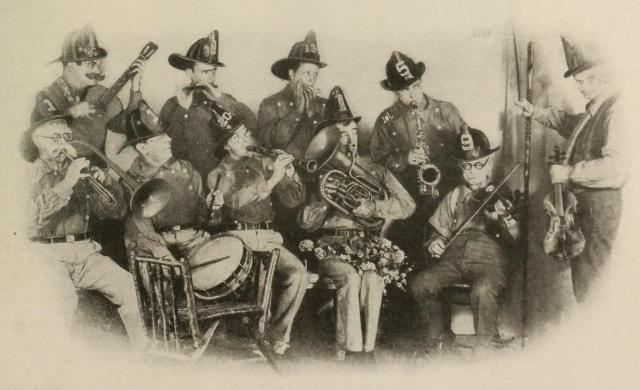
Yet another show for which Browne was responsible was Ward’s Tip Top Club, a variety show with Cookie’s Orchestra. During the summer of 1931 Bert Lown and his Biltmore Orchestra co-starred on the show and provided the musical accompaniment.

Browne’s Nit Wit Hour left the air early in 1931 to provide airtime for a sponsored program but was then brought back that summer. The show disappeared for good when Browne departed WABC at the end of 1931 to go to work for NBC. In December of that year he succeeded Ray Perkins as the master of ceremonies of WJZ’s Three Bakers with Billy Artzt’s orchestra, under the sponsorship of the Continental Baking Co. Another of Browne’s NBC responsibilities was hosting The Colgate House Party in 1934 that featured the singing of Donald Novis. He continued to partner with Llewelyn on the air in a 1933 series sponsored by the Household Finance Corporation, 1934’s The Tastyeast Program over WEAF, and an unidentified show sponsored by General Baking in 1935.

By 1938 Browne had mostly moved away from performing on the air and was working primarily behind the scenes as a studio director for N. W. Ayer & Son, one of the premier advertising companies of the time. Among the shows he worked on for the company were Al Pearce & His Gang in the late 1930s. In 1938 Browne was transferred by the company to its Hollywood office and he would spend his remaining years in California. One of his West Coast responsibilities was producing The Ford Summer Hour in 1940.

During the 1940s Bradford (now just as often referenced as Brad) Browne moved between several jobs, primarily in producer or director roles. Browne went to work for J. Walter Thompson Co. in 1941 where he replaced Tony Stanford as producer of The Gene Autry Melody Ranch on CBS. Two years later in 1943 he moved on to Ruthrauff & Ryan where he produced NBC’s weekly Gilmore Furlough Fun, an early Spike Jones series. Browne was also charged with producing the thrice-weekly Red Ryder, a responsibility he held until the late 1940s. In 1947 Browne replaced Paul Franklin as director of The Zane Grey Show over the Don Lee-Mutual network.

Browne’s radio career appears to have wound down with the end of the 1940s; he has sparse radio credits after that time and not much is known after this period. The family would gain a small amount of fame half a century later when his son, Harry Browne (perhaps named after his brother, the Harry Browne of 1930’s Showboat fame), ran for President of the United States in 1996 and 2000 on the Libertarian Party ticket. Few artifacts of Browne’s entertainment seem to have survived, just a 1930 book about The Nit Wit Hour and some sheet music, the result of writing and publishing hundreds of songs over his lifetime.