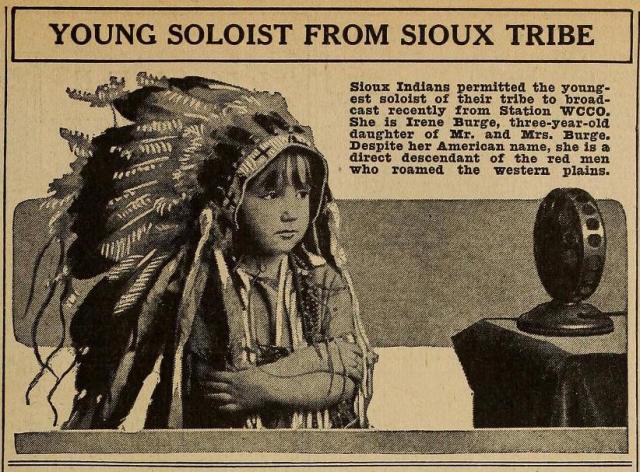
From the 1938 Radio Annual.
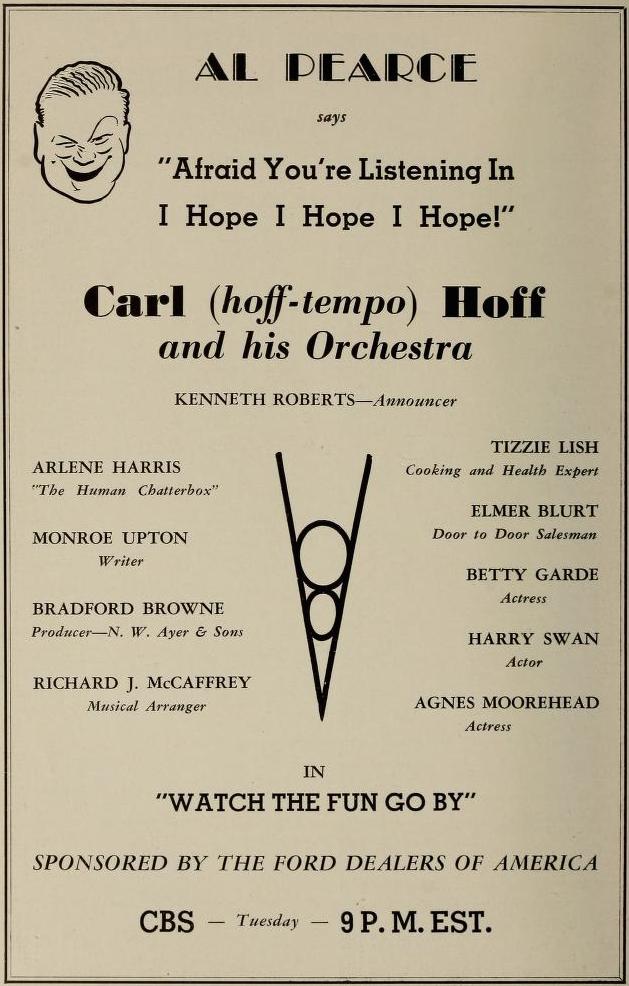

From the 1938 Radio Annual.
Originally published in the Old Radio Times, 2017
In the case of Browne and Llewelyn, however, there was a good deal of legitimate talent. A man working for Newark’s WGCP overheard the duo and persuaded them to appear on his station, possibly as early as 1925. Browne spent much of his free time hanging around the studios and one day a station announcer failed to appear at his scheduled time so Browne stepped in to cover the duty. Ownership was impressed and Browne was quickly hired to handle some announcing responsibilities, and within a short time he also found himself director of the station’s continuity.
In 1926 Bradford Browne wrote what is believed to be his first broadcast feature, a series called Cellar Knights. It featured him and Llewelyn as Ham and George, two black janitors in a New York City apartment. Within a year or two New York’s WABC, then a part of Alfred Grebe’s Atlantic Broadcasting Company, contacted Bradford and he left for a job at the larger station. He took his Cellar Knights program with him and when WABC became an affiliate of the new Columbia Broadcasting System in 1928, the network began airing the series over its web. A Milwaukee theater bill from this era indicates the two were also performing professionally at least on occasion on the dwindling vaudeville circuit.
Within a short time Browne found himself involved with a number of WABC productions including Cellar Knights, Tramp, Tramp, Tramp (about the life of a hobo), The Old Lady Who Lived in a Shoe (a musical production), The Gossipers (about laborers on New York’s Lower East Side), SS Pumpernickel, Aunt Jemima, Then and Now, and The Nit Wit Hour. The latter show brought no small bit of acclaim to Browne and the series ended up running for nearly three years, from early 1929 to late 1931. The kernel of the program was created by Georgia Backus but it was Browne who fleshed out the details and brought it to the airwaves. Browne was so particular about broadcasting comedy that he later claimed to have written six 30-minute scripts before he felt comfortable with the material he wanted aired on the show’s debut. “They don’t care,” Browne explained, “who you are or what you might give them later in the program. It’s what you’re giving them every instant that counts and you either give them a thrill or a laugh a minute or you lose two or three million listeners.”
Browne wasn’t confined to just entertainment programs, however. At Herbert Hoover’s 1929 inauguration Browne was one of the reporters assigned to cover the ceremony for the entire CBS chain. He was regularly called on by the station to report local news stories.
From 1929 to 1931 while both employed by WABC, Browne and Llewelyn were paired up for a number of regular broadcasts. The pair engaged in songs and patter on Three Little Sachs, accompanied by Emery Deutsch and The Meridians. Sponsored by a salad dressing producer, the duo starred on Premier Salad Dressers with their so-called “synchronized conversation.” He and Llewellyn teamed up yet again for a three-times weekly program sponsored by La Palina during which they told jokes and sang as the Senator (Browne) and the Major (Llewellyn). Various musicians provided the music including Freddie Rich and his orchestra and tenors Larry Murphy and Ben Alley. This may have been an early incarnation of their Colonel and the Major routine that would be remembered for many years to come.
Originally published in the Old Radio Times, 2017
In 1929 Edson Bradford Browne found himself one of the busiest men in New York City radio. For a man who just a few short years earlier was earning a paycheck as a department store floor walker in Newark, Browne saw nearly unlimited in the rapidly developing world of commercial broadcasting as a new decade was about to begin.
Born December 31, 1890, when the very earliest radio experiments were just getting under way in laboratories around the world, no one in North Adams, MA, could have anticipated his future career at the time of his birth. His parents were Isaac Snell Browne and Elizabeth Tobin, neither of whom held a position that would naturally lead a boy into radio. But then, most of the medium’s earliest professionals happened into the field by chance, and such is Bradford Browne’s story.
As a child Browne entertained family and friends banging on the piano and plucking the banjo. He never took lessons nor ever seemed to seriously consider a performing career. Perhaps seeing his father’s work as a minstrel end man lead to little, Browne chose a different path. Instead, he decided he might want to pursue law. Browne enrolled in Georgetown University where he eventually graduated with honors from the law program. Within a few years the United States entered World War I and he enlisted and was subsequently assigned to the 101st Regiment as a personnel corporal. In the middle of war Browne returned to his childhood roots, entertaining and writing songs he performed for his brothers in arms.
With little direction Browne wandered from job to job after leaving the Army. He worked as a stenographer in Washington, D.C. and as a lawyer before going to work as a floorwalker for a department store in Newark, NJ. On his own time he began singing with a man named Al Llewelyn, a former steel plant manager who had lost his job and was then staying at the same boarding house as Browne. Unbeknownst to both, a doorway to radio was opened to them. Station managers at the time were ever on the lookout for talent to fill airtime; talent was secondary to reliability.
Originally published in the Radio Listeners Lyceum, 2013.
On June 7 (originally scheduled for May 31) the Play-Ask-It-Ball crew journeyed to the Naval Reserve Midshipmen’s School in Chicago. The contestants were apparently getting comfortable with the show’s format because every week seemed to see scores get higher and higher. During this episode the Navy contestants scored 22 runs to pull within four runs of Army in the standings.
Standings: Navy 40, Army 44
When round two started on June 14 the show returned to the Great Lakes Naval Training Station. Commander T. Dewitt Carr, new executive officer of the station, spoke after the conclusion of the quiz during what was now being billed as the seventh inning stretch. The Navy’s men came through and pulled ahead of Army with a fourteen-run performance.
Standings: Navy 54, Army 44
The following week for the 8th show Fogarty and company returned to Fort Sheridan on June 21. The evening’s speaker was Lieut. Sidney DeLove, Fort Sheridan’s provost marshal. From here on out the scores were rarely reported so weekly standings are unknown.
Episode 9, broadcast June 28, was a return engagement to the Naval Reserve aviation station in Glenview, IL. Lieutenant Commander Richard K. Gaines was the post-quiz speaker again.
During the July 5 production the WGN team returned to Rockford’s Camp Grant where Brig. Gen. John M. Willis, the camp’s commanding officer, spoke to listeners afterward.
As of July 19, 1941, when Play Ask-It-Ball completed its second round in Camp Forrest at Tullahoma, TN, Navy had taken the lead in the two-team standings. Maj. Gen. Samuel T. Lawton again spoke during the seventh inning stretch.
On July 26 the third and final round of the armed forces quiz show hit the air. WGN’s production crew returned one last time to the Great Lakes Naval Training station with Army leading Navy 94 to 82. Unfortunately, this is the last score so far discovered in research of the program.
Play-Ask-It-Ball returned to Gleview, IL, and the Naval Reserve Aviation school on August 9 and the following week, August 16, Brickhouse and Kirkpatrick made made their third and final appearance at Camp Grant in Rockford.
The final broadcast in the Play Ask-It-Ball series aired August 30. It was hyped as the first radio quiz show to be aired from the scene of Army maneuvers, a mock battlefield near Camden, AR. The Illinois soldiers who had been located at Camp Forest, Tullahoma, TN for their previous two appearances, were on maneuvers with the second Army, necessitating the change in broadcast origination. Army went into the final contest down twelve runs. Did they overtake their Navy opponent or fall just short? The historical documents don’t record the ultimate winner of the series.
Play-Ask-It-Ball may have been the first quiz show to feature members of the military but it was not the last. Jim Cox has identified at least one other, The Army-Navy Game featuring Fred Uttal. This series premiered the following year, 1942, and appeared on NBC Blue and the Mutual system until 1944. Interestingly, there’s no indication that WGN considered reviving Play-Ask-It-Ball after World War II broke out just a few months after it left the air.
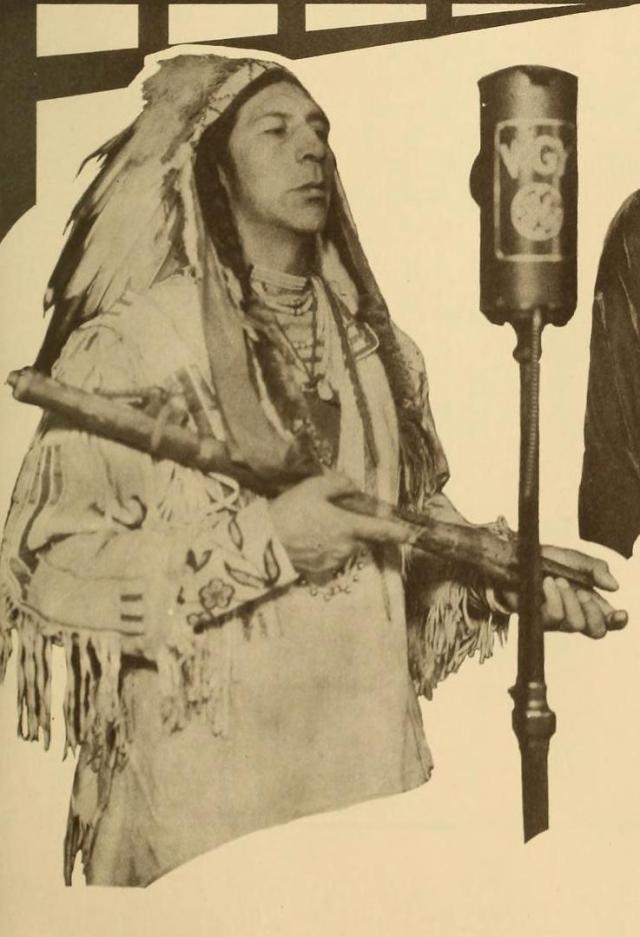
“Max Bigman, Crow Indian chief, with his love lute, has proven an attraction at WGY [Schenectady, NY]”.
Originally published in the Radio Listeners Lyceum, 2013.
Play-Ask-It-Ball premiered on WGN on Saturday, May 3, 1941, at 7:00 in front of an enthusiastic live audience of over 1,500 sailors in the drill hall at the Great Lakes Naval Training Station in North Chicago. During the debut broadcast the sailors managed four runs during the half-hour program.
Standings: Navy 4, Army 0
For the second show the WGN crew traveled to Fort Sheridan, just north of Chicago, for the 7:00 broadcast. Again an estimated 1,500 servicemen packed into a gymnasium to see five fellow soldiers compete in the contest. The team proved more than capable, tripling up the number of runs scored by the previous week’s team with twelve, giving the Army an eight run lead in the standings. After the quiz portion had ended Brig. Gen. John L. Homer, commandant at Fort Sheridan, spoke to listeners.
Standings: Navy 4, Army 12
The third episode aired May 17 from the Naval Reserve Aviation Training base at Glenview, IL. Following the quiz portion of the show Lieutentant-Commander R. K. Gaines, commanding officer of the aviation base, gave a short update to listeners on the base’s training activities. A prodigious output of scoring by the Navy men put them up by six runs over their Army counterparts.
Standings: Navy 18, Army 12
Episode four aired May 24 from Camp Grant, Rockford, IL. Camp Grant’s soldiers were up for the task and knocked in a whopping fourteen runs to leapfrog their Navy peers who had earned an impressive 18 runs in their first two outings. Notably, a female participant was chosen for the night’s broadcast and she proved her worth. Lieut. Dorothy Case, a nurse at the camp’s hospital and perhaps the series’ only female participant, went two for three on the night. Col. Joseph Hamilton Davidson, commanding officer, was the guest speaker at the end of the broadcast.
Standings: Navy 18, Army 26
The fifth broadcast was made from the only base outside the Chicago metropolitan area. For the May 31 show (originally scheduled for June 7), WGN’s team traveled all the way to Tullahoma, TN, where they set up at Camp Forrest to perform with members of the Illinois National Guard units. That evening the soldiers amassed a show-record eighteen runs during the half hour. Maj. Gen. Samuel T. Lawton, commanding officer of the 33rd division, discussed the role of the camp in national defense.
Standings: Navy 18, Army 44
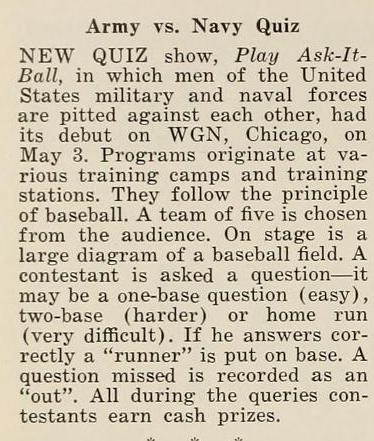
A regional broadcast, Play-Ask-It-Ball nevertheless got a mention in the May 12, 1941 issue of Broadcast.
Originally published in the Radio Listeners Lyceum, 2013.
The radio quiz show was a staple of the airwaves during the 1940s and by the end of the decade the genre could claim enough listeners that Bert Park’s Stop the Music! is credited with knocking the number one show of the 1947-48 season, The Fred Allen Show, entirely out of the top 20 the next year. The earliest quiz program is unknown but John Dunning points to Professor Quiz in 1936, an assessment which Jim Cox, author of the authoritative guide to radio quiz and audience participation shows, does not dispute.
In 1941 staff at Chicago’s WGN developed a twist on the quiz show concept by pitting Naval seamen against Army soldiers. Though not yet engulfed in World War II, the eyes of America were warily watching Europe and East Asia erupting in war. The military services were gearing up in case the United States found itself dragged into the overseas conflicts and it seemed natural to bring the good-natured rivalry between service branches to the airwaves.
Whether Paul Fogarty originated the concept, he was called on to develop and act as producer of the new show, Play-Ask-It-Ball. Fogarty had been with WGN for over a decade, starting first as a writer and actor on local series such as Big Leaguers and Bushers and The Devil Bird in 1932. He had gradually been given more sports-related broadcasts and most of his responsibilities were off-mike by 1941.
The series would be broadcast from a number of military bases and at each location a five-person team would be chosen from audience members. They were brought up on a stage on which was laid out a replica of a baseball diamond. Despite its name, the game show was an adaptation of baseball, not basketball. Play-Ask-It-Ball required little physical movement; rather, hits and runs were earned not by athletic prowess but by correctly answering questions. Graded on four degrees of difficulty, questions from fifteen possible subjects could be worth either a singe, double, triple, or home run. Topics ranged from sports and movies to geography, the Army, and the Navy.
Jack Brickhouse, a Peoria, IL-born sports announcer was called upon to act as emcee and “pitch” questions to the participants. Brickhouse had arrived at WGN only the year before in 1940 primarily to serve as announcer for Cubs and White Sox baseball games. Jess Kirkpatrick, a local actor who went on to a long career first in radio and then in television, handled the new program’s announcing duties. He umpired the games and called all the plays.
Contestants were moved around the diamond as teammates answered additional questions correctly. A question assigned the difficulty of a single was worth one dollar to the answerer. A double earned the player two dollars, a triple three dollars, and a home run a whopping four dollars. An incorrect answer was rung up as an out.
Six sites were chosen to host the show, three representing the Navy and three representing the Army. At each site the host team earned runs for their respective service and the runs would accumulate week after week. Play-Ask-It-Ball was to rotate through the six-team circuit three times for a total of eighteen broadcasts. After all eighteen quiz shows the winning service branch would be determined by the accumulated number of runs scored over the successive weeks.